
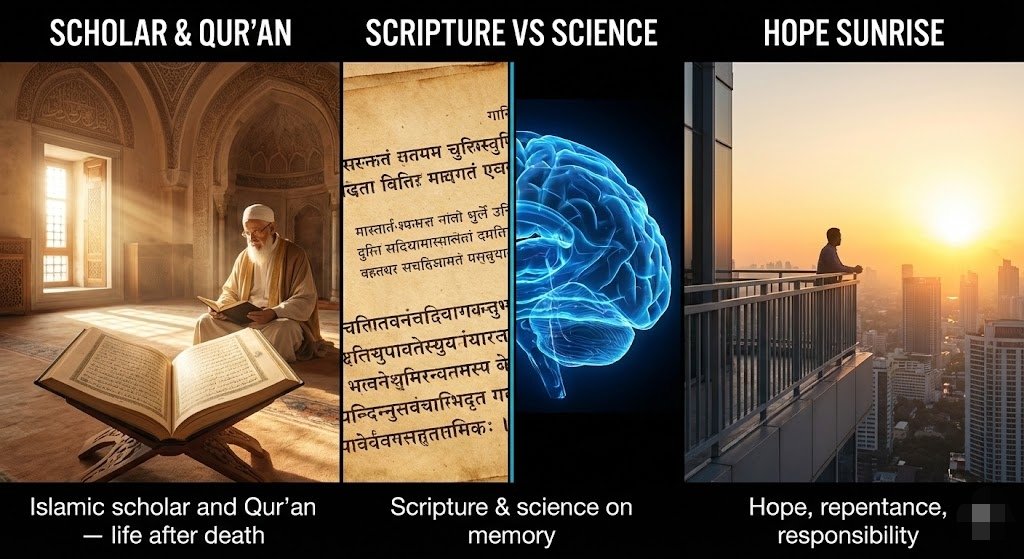

Why Reincarnation Is Not the Truth — Islamic Teachings, Science & Clear Reason
Many people wonder: “Is reincarnation true? Do we return in another life?” This article answers gently and clearly — using the Qur’an (Saheeh International translation), trustworthy scholarship, and modern science — and explains why the doctrine of repeated bodily rebirth does not stand up to evidence, reason, or the Islamic creed.
Quick summary
- Islamic revelation affirms one worldly life followed by Resurrection and accountability.
- “Past-life memories” usually have better explanations: memory, suggestion, cultural influence, or physiological states.
- Extreme fasting, sensory deprivation, or ascetic trance can produce vivid hallucinations — well-documented by medical research.
- Belief in reincarnation can weaken immediate moral responsibility; Islam invites upright action and hope now.
1. The memory problem — why only adherents “remember” past lives
A central difficulty for claims of reincarnation is that ordinary people rarely, if ever, suddenly recall previous bodily lives — the reports of past-life memories come almost entirely from those already sympathetic to that idea. A famous case is the Bridey Murphy / Ruth Simmons story: Simmons recovered “memories” that matched an Irish woman’s life, but investigations found a likely source of those memories in Simmons’ environment rather than clear evidence of rebirth.
Read a careful historical summary and analysis showing how suggestion and cultural memory can explain such cases rather than reincarnation.
The Bridey Murphy episode and similar hypnotic-memory cases have scholarly commentary and clinical notes that caution against treating hypnotic recall as proof of reincarnation.
2. Science: no mechanism for personal identity transfer — plausible alternatives exist
Reincarnation requires that an individual’s personal identity survive death and transfer to another body. Modern philosophy and cognitive science find no plausible mechanism for that transfer. Philosophers such as Paul Edwards have exhaustively reviewed reincarnation claims and argued that they fail to meet the standards of evidence required for extraordinary assertions.
Hallucinations, suggestion, and the brain
Medical research shows that physiological states — for example, prolonged fasting, low blood glucose (hypoglycemia), sensory deprivation, or trance practices — can produce vivid perceptual experiences, hallucinations, or memory distortions. These are well-documented in clinical literature and help explain why intense ascetic practices sometimes produce striking visions that later become interpreted as mystical or “past-life” experiences.
3. Historical and textual context — not originally in early Vedic texts
Careful scholarship into the development of Hindu doctrines indicates that the specific later ideas about cyclical rebirth and transmigration matured over time and are found prominently in later Puranic literature and particular philosophical systems, rather than as a simple, clear teaching in the earliest Vedic material. Some Hindu scholars themselves note the later development of such doctrines.
4. What the Qur’an says — a clear theological answer
“Life is not but our worldly life — we die and live, but we will not be resurrected.” — Surat Al-Mu’minūn (23:37)
“Have they not considered how many generations We destroyed before them who will never come back to them?” — Surat Yā-Sīn (36:31)
“They will not taste death therein except the first death.” — Surat Ad-Dukhān (44:56)
These verses show a consistent Qur’anic emphasis: the worldly life is unique and the true return (and full accounting) is not a cycle of repeated earthly lives but Resurrection before Allah. Classical tafsīr (for example Al-Qurtubī, Ibn Kathīr) explains these verses as a direct response to claims that deny resurrection or suppose a return to worldly life as a substitute for Resurrection.
5. Moral consequences — responsibility, repentance, and hope
A belief system that postpones moral accountability to an indefinite future life may encourage complacency: “I can do this now because I will get another chance later.” Islamic teaching stresses immediate responsibility — repentance, good deeds, and trust in Allah’s Mercy. This cultivates ethical urgency and sincere reform in this life.
6. Ascetic visions vs prophetic miracles
Islamic tradition warns about severe self-imposed austerity that can lead to error. Eminent scholars noted that extreme deprivation, when combined with ignorance, may open a person to false whispers and delusive experiences — quite different from the clear, witnessed miracles granted to Prophets, which were public and incontrovertible.
7. Practical guidance for the sincere seeker
- Seek knowledge from reliable Qur’anic tafsīr and qualified scholars — avoid accepting extraordinary claims without solid evidence.
- Avoid extreme ascetic practices that harm the body and mind; balanced worship and care for the body are encouraged in Islam.
- Hold hope in Allah’s Mercy and practice moral responsibility now: repentance and good works matter in this life.
- If you encounter alleged “past-life memories,” consider psychological and medical explanations and consult knowledgeable experts.
Conclusion — hope, reason, and responsibility
Reincarnation — understood as repeated bodily rebirths — lacks a convincing scientific mechanism, is often better explained by memory and physiological states, and conflicts with the clear Qur’anic message of Resurrection and final accountability. The balanced Islamic path invites sincere faith, repentance, and upright action here and now, with hope in Allah’s Mercy.
Sources & further reading
- On the Bridey Murphy / Ruth Simmons case and historical commentary (see comparative religious critiques and hypnotic-memory analyses).
- Clinical and medical research on hypoglycemia, endorphin response, and hallucination: PubMed / NCBI research summaries.
- Paul Edwards, Reincarnation: A Critical Examination — philosophical review of reincarnation claims.
- Qur’anic verses (Saheeh International) linked above for direct reading on Quran.com.
- Islamic explanation and scholarly responses — consult reliable tafsīr (Al-Qurtubī, Ibn Kathīr) and reputable fatwa/scholarly sites for detailed Q&A.
Kindly, Share this article