
The Origin of Reincarnation Beliefs:
A Scientific, Scriptural, and Islamic Examination
An evidence-based exploration of repeated births, reincarnation, ascetic visions, and the Islamic understanding of life, death, and creation.
Many people across the world encounter the idea of reincarnation or repeated births through philosophy, culture, or spirituality.
Islam approaches such questions with clarity, mercy, and reason — addressing both the mind and the heart.
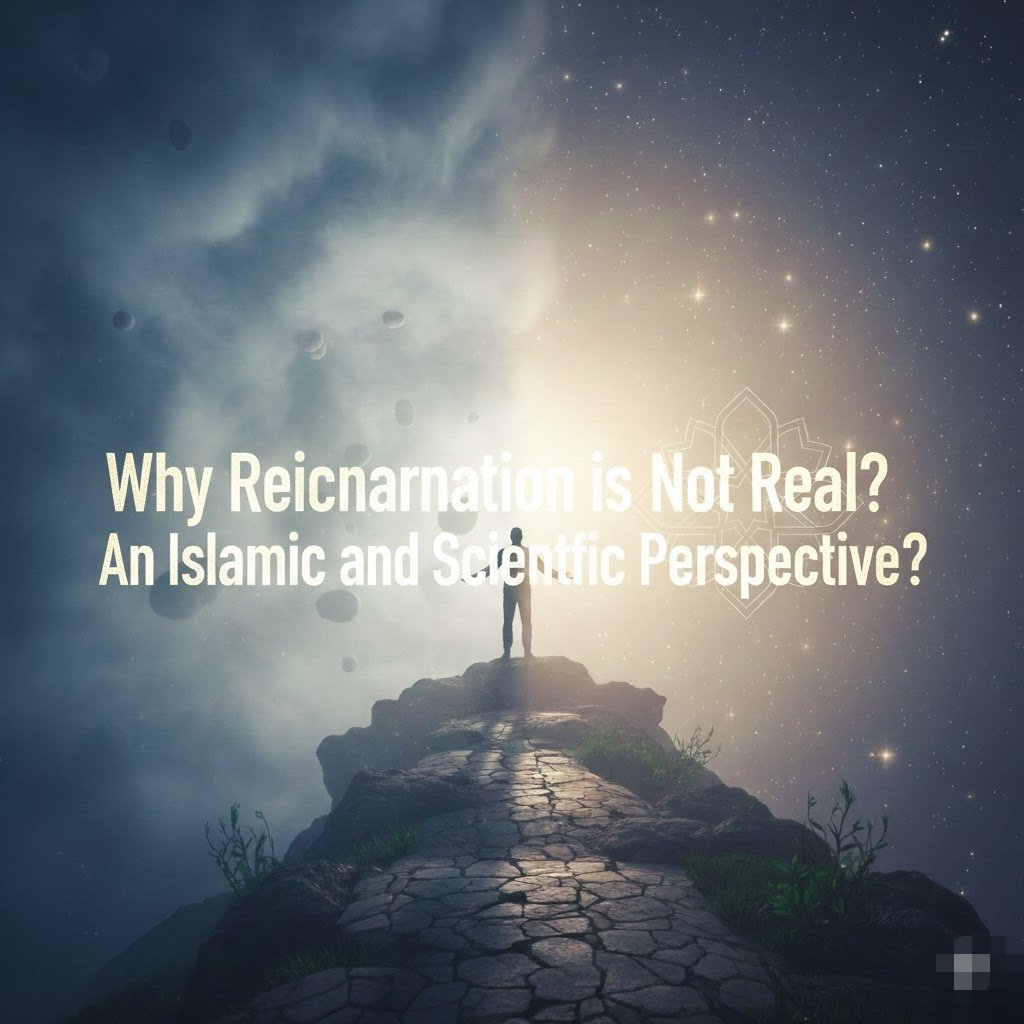
This article calmly examines the origin of reincarnation beliefs, compares them with scientific findings, and presents the Islamic worldview using authentic sources — inviting the reader to reflect sincerely and peacefully.
Where Did the Idea of Repeated Births Come From?
One of the most striking facts acknowledged by historians of religion is that no one truly knows who first introduced the idea of reincarnation, nor when it began.
- No known founder
- No original scripture confirming it
- No empirical proof supporting it
Even more importantly, the ancient Vedas do not contain any explicit mention of soul transmigration or samsara.
These ideas only appeared much later in the Puranic philosophies, long after the Vedas were composed.
Ascetic Practices, Hallucinations, and Modern Science
Some Hindu monks practiced extreme ascetic rituals known as Prāṇa disciplines, involving:
- Long hours of immobility
- Severe fasting
- Deprivation of food and water
Modern neuroscience explains the consequences of such practices.
Prolonged fasting leads to low blood glucose levels, which disrupts brain chemistry and causes hallucinations.
According to the U.S. National Center for Biotechnology Information (NCBI), reduced glucose levels can result in hallucinations and altered perceptions.
NCBI PubMed – Hypoglycemia & Hallucinations
What some monks experienced — and later recorded in the Puranas — aligns far more with neurological hallucination than divine truth.
A Warning from Islamic Scholarship
“When a worshiper devoid of knowledge adopts extreme hunger and isolation, the devil enters freely, while the person assumes he has reached a high spiritual rank.”
— Imām adh-Dhahabī رحمه الله
(Siyar Aʿlām an-Nubalāʾ)
Islam strongly discourages self-inflicted hardship that leads to spiritual confusion rather than clarity.
Allah says:
“Say, ‘Who has forbidden the adornment of Allah which He has produced for His servants and the good things of provision?’”
The Prophet ﷺ said:
“Do not impose hardships upon yourselves lest Allah impose hardship upon you…”
Sunan Abū Dāwūd 4904 — Authentic
Do Prophetic Miracles Resemble Ascetic Visions?
There is a clear distinction between:
- Hallucinations resulting from deprivation
- Miracles witnessed publicly and suddenly
Prophets did not prepare their minds through starvation or isolation.
Their miracles, with which Allah supported them, occurred openly, were witnessed collectively, remain beyond human replication, and people would see and witness them with their own eyes; and that no human can produce the like of these miracles. This is the difference between the prophets’ events and those seen by Hindu monks.
How Islam Views the Universe
Some philosophies claim the universe endlessly collapses and reforms.
Modern cosmology, however, confirms a singular beginning. This conception about the disintegration and formation of the universe is scientifically erroneous.
Scientifically, the universe was not preceded by other universes; rather, it was created and built in an unprecedented manner.
Allah says:
“The Originator of the heavens and the earth. When He decrees a matter, He only says to it, ‘Be,’ and it is.”
This truth that this universe was created in an unprecedented way was revealed to Prophet Muhammad ibn ‘Abdullāh, the Messenger of Allah and the Prophet of Islam ﷺ — a shepherd in Makkah — over 1,400 years ago, long before modern astronomy.
A Gentle Invitation to Reflect
Islam does not dismiss human experience — it explains it.
It does not deny spirituality — it anchors it in truth.
There is one life, one death, and one return to Allah — a belief rooted in revelation, reason, and mercy.
May this reflection be a step toward clarity, peace, and sincere seeking.