

True Nobility in Islam: Why Divine Piety Eclipses Lineage and the Truth of the Prophetic Interval
An insightful exploration of spiritual equality, accountability before Allah, and the absolute finality of guidance during the historical era of the Fitrah.
1. The Illusion of Inherited Status: Lineage vs. Personal Righteousness
My dear friends, it is a natural human instinct to seek honor, connection, and a sense of belonging. Throughout history, communities have built complex social hierarchies based on family trees, bloodlines, and ancestral heritage. In some societies, individuals proudly claim the title of “Al-Ashraf” (the Nobles), carrying certified documents that trace their physical lineage directly back to the pure household of our beloved Prophet Muhammad ﷺ (Ahl al-Bayt).
But let us pause and reflect with an open, sincere heart. To put it in plain, uncompromising terms: if a person relies solely on their ancestry while neglecting their relationship with the Creator, that paperwork holds absolutely no spiritual value. In the sight of Allah, a single sincere believer born to a non-Muslim family in the furthest corner of northern Sweden, who embraces Islam out of pure conviction and guidance, is infinitely better than thousands of Muslims who hold prestigious certificates of Prophetic descent but live lives detached from the commandments of Islam. Noble ancestry is never a free pass to bypass moral accountability.
“Look at the profound, sobering counsel of Ameer al-Mu’minin, Umar ibn al-Khattab (may Allah be pleased with him), when he addressed Sa’d ibn Abi Waqqas—a towering figure in Islamic history. Sa’d was one of the ten promised Paradise, the very first to shoot an arrow in the cause of Allah, a member of the elite consultative council (Shura), and a legitimate candidate for the Caliphate itself! Yet, Umar warned him with absolute candor:”
“O Sa’d ibn Waheeb! Let it not deceive you regarding Allah that it is said, ‘The maternal uncle of the Messenger of Allah ﷺ and his companion’—for Sa’d was from the clan of Aminah, the Prophet’s mother. Indeed, Allah does not erase evil with evil, but He erases evil with good. Truly, there is no kinship between Allah and anyone except through obedience to Him. The noble and the ordinary among them are entirely equal in the sight of Allah. Allah is their Lord and they are His servants; they excel one another only by virtue of well-being (Aafiyah), and they attain what is with Allah solely through obedience.”
— Traced through established historical and theological principles of accountability, accessible on IslamQA.
Umar ibn al-Khattab finished his powerful admonition by highlighting the ultimate metric of success: “Look to the matter which you saw the Messenger of Allah ﷺ upon, from the moment he was commissioned until he left us, and adhere strictly to it—for it is the ultimate command. This is my advice to you; if you leave it and turn away from it, your deeds will be rendered null and void, and you will surely be among the losers.”
If the maternal uncle of the Prophet ﷺ and a guaranteed dweller of Paradise was reminded that physical proximity offers no protection without active obedience, where does that leave the rest of humanity? Consider the vivid lessons preserved in divine history:
- ✕
Abu Lahab: The biological paternal uncle of Prophet Muhammad ﷺ, yet eternally condemned in the Quran because of his rejection of truth. - ✕
The Son of Noah: The direct biological child of a great Prophet, who drowned in the flood because he refused to board the ark of faith. - ✕
The Wives of Noah and Lot: Bound in holy matrimony to chosen Messengers of God, yet their marital ties could not save them from divine justice.
This is the beautiful, liberating egalitarianism of Islam. True nobility is not anchored in DNA; it is anchored in the heart. As Allah explicitly declares in the Holy Quran:
“يَا أَيُّهَا النَّاسُ إِنَّا خَلَقْنَاكُمْ مِنْ ذَكَرٍ وَأُنْثَى وَجَعَلْنَاكُمْ شُعُوبًا وَقَبَائِلَ لِتَعَارَفُوا إِنَّ أَكْرَمَكُمْ عِنْدَ اللَّهِ أَتْقَاكُمْ”
“O mankind, indeed We have created you from male and female and made you peoples and tribes that you may know one another. Indeed, the most noble of you in the sight of Allah is the most righteous of you.”
2. The Prophetic Interval (Al-Fatrah): Dispelling Historical Misconceptions
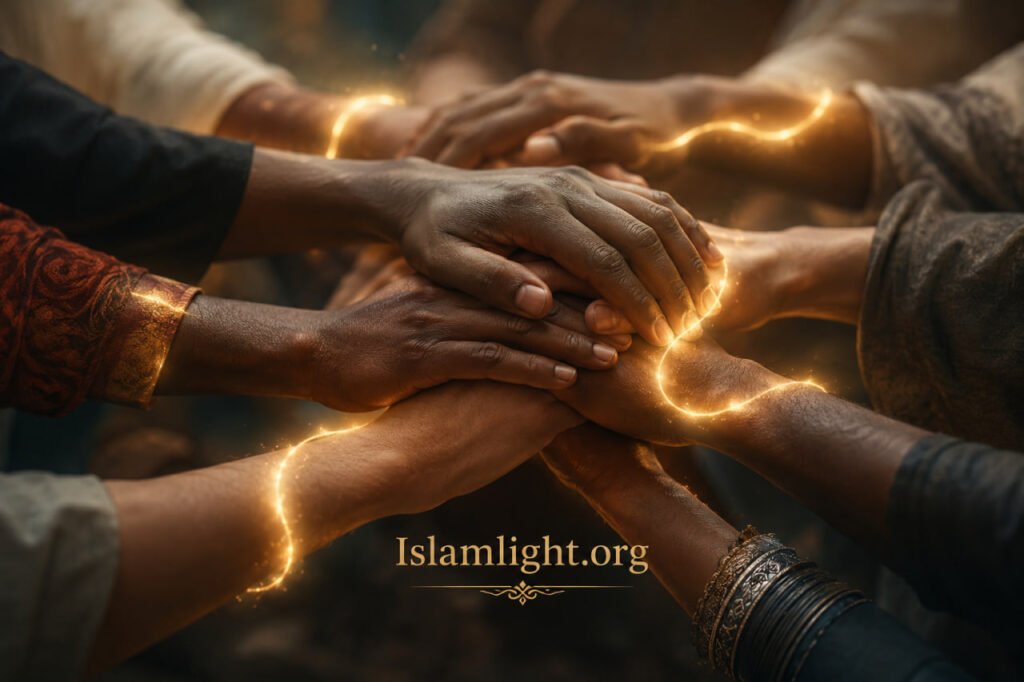
Let us now address an important academic and historical discussion regarding the period known as Al-Fatrah—the historical time gap between the departure of Prophet Jesus (Isa) peace be upon him and the final arrival of Prophet Muhammad ﷺ.
Certain historical accounts and classical commentaries mention individual figures among the pre-Islamic Arabs, such as Khalid bin Sinan or Hanzala bin Safwan, occasionally labeling them as prophets who appeared within that interval. Popular statements like “He was a prophet whose people neglected him” are sometimes cited in literature. However, a rigorous analysis of authentic Islamic evidence reveals that the narrations supporting their prophethood are highly weak (Dha’eef) and cannot be used as reliable theological facts.
In reality, the explicit, authentic text of the Sunnah completely rules out the existence of any intervening prophets between Jesus and Muhammad ﷺ. As recorded in the foundational collection of Sahih al-Bukhari:
“The Messenger of Allah ﷺ said: ‘I am the closest of all people to Jesus, the son of Mary, both in this world and in the Hereafter. The Prophets are paternal brothers; their mothers are different, but their religion is one, and there is no Prophet between myself and him.'”
Those upright individuals during the pre-Islamic era who rejected idolatry—such as the famous Hanifs—were simply righteous people who preserved the residual monotheistic teachings of Prophet Abraham (Al-Haneefiyyah). They were not divinely sent Messengers or law-giving Prophets.
The definitive purpose of this historical interval was to leave humanity completely without excuse upon the arrival of the final message. Allah addresses this explicitly to the people of the book in Surah Al-Ma’idah:
“وَلِلَّهِ مُلْكُ السَّمَاوَاتِ وَأُنْثَى وَالْأَرْضِ وَمَا بَيْنَهُمَا وَإِلَيْهِ الْمَصِيرُ * يَا أَهْلَ الْكِتَابِ قَدْ جَاءكُمْ رَسُولُنَا يُبَيِّنُ لَكُمْ عَلَى فَتْرَةٍ مِّنَ الرُّسُلِ أَن تَقُولُواْ مَا جَاءنَا مِن بَشِيرٍ وَلاَ نَذِيرٍ فَقَدْ جَاءكُم بَشِيرٌ وَنَذِيرٌ وَاللَّهُ عَلَى كُلِّ شَيْءٍ قَدِيرٌ”
“And to Allah belongs the dominion of the heavens and the earth and whatever is between them, and to Him is the final return. O People of the Scripture, there has come to you Our Messenger to make clear to you [the religion] after a period of a cessation of messengers, lest you should say, ‘There came not to us any bringer of good tidings or a warner.’ But there has come to you a bringer of good tidings and a warner. And Allah is over all things competent.”
This direct Qur’anic address clarifies that following the long pause in active revelation, the arrival of Prophet Muhammad ﷺ effectively removed any excuse for those who claimed ignorance of divine guidance. Once the light of truth reaches a person, the obligation to recognize and follow it becomes absolute.