

The Unbroken Chain: Tracing the Original Call of Monotheism
An invitation to reflect on the origins of faith, grounded in anthropology, history, and the Divine Revelation.
In the name of Allah, the Most Gracious, the Most Merciful.
My dear brothers, sisters, and seekers of truth, have you ever paused to wonder where the idea of “God” truly came from? Did our ancestors invent religion out of fear of thunder and lightning? Or is there a deeper, ancient memory etched into the soul of every human being—a memory of the One true Creator?
With hearts open to guidance, let us journey through history and science to uncover a truth that many have overlooked: that belief in One God is not an evolution, but the original state of mankind.
1. Did Religion Begin with Fear?
Some materialist thinkers have long claimed that primitive man invented religion because he was terrified of cosmic phenomena like storms or eclipses. They argue that to appease these “scary” forces, humans invented rituals. But let us use our reason for a moment.
If fear was the only driver, why did religion produce feelings of magnificence and spiritual longing in every civilization, rather than just cowardice? Furthermore, natural phenomena occur with regularity. Once a “primitive” man sees the sun rise and set a thousand times, it ceases to be a mystery. Why, then, did the religious impulse remain?.
“Religion has always been a universal element in human societies… its origin must be completely independent of this inadequate reductionist analysis put forward by atheists.”
The Totem Fallacy
Others, like sociologist Émile Durkheim, claimed religion started with “Totemism”—clans worshipping animals or symbols. However, modern anthropology has dismantled this view. Scholars found vast civilizations that believed in a Supreme Being without ever having totems. Totems were merely social identities, like flags for a country, not gods.
2. Monotheism: The First Faith
Here is where the evidence becomes truly breathtaking. Contrary to the idea that humans “evolved” from worshipping many gods to one God, the historical record suggests the opposite.
Famous anthropologists like Wilhelm Schmidt and Andrew Lang studied the most isolated, “primitive” tribes on Earth—such as the African Pygmies and Australian Aboriginals. What did they find?
- ✔ Pure Belief: These tribes believed in a “High God”—a single, benevolent Creator who is omniscient (all-knowing).
- ✔ Erosion, Not Evolution: The evidence showed that Monotheism came first. Polytheism (worshipping many gods) was a later corruption or degeneration of that original truth.
As researcher M. Monier Williams asserted, “Monotheism preceded all forms of polytheism which appeared later”.
3. Finding the One God in Ancient Texts
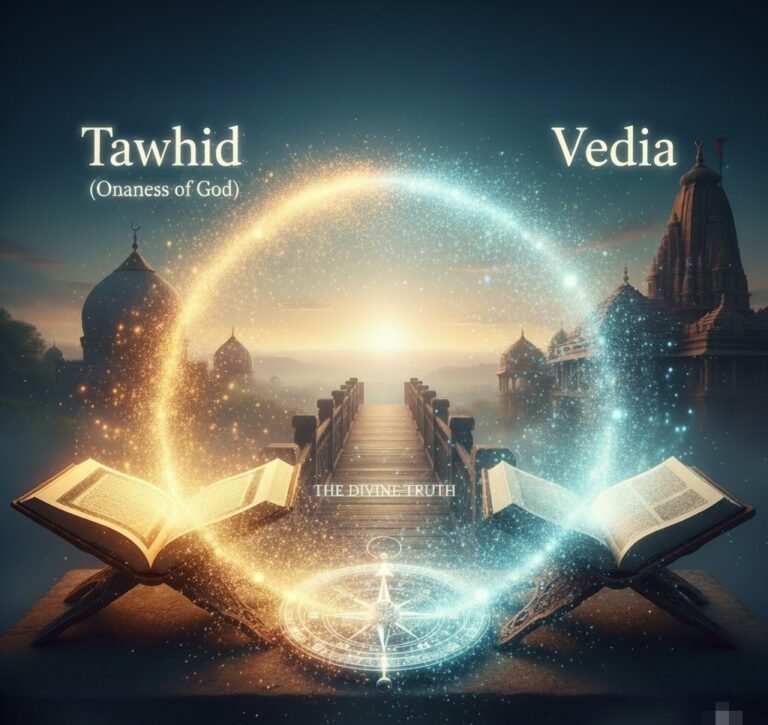
When we look with eyes of justice at the major world religions today, we find that at their very core, buried under centuries of tradition, lies the concept of the One Supreme Creator.
🕉️ Hinduism
Research concludes that the majority of Indians originally held a strong belief in One Supreme Being. The path of the Sadhu involves renouncing earthly deities to devote oneself to the One First Creator.
✝️ Christianity
The Bible’s greatest commandment is clear: “Hear, O Israel: The Lord our God, the Lord is one” (Deuteronomy 6:4). Even Jesus (peace be upon him) reiterated this in Mark 12:29. The Trinity was a later theological development.
🔥 Zoroastrianism
Originally, Zoroaster taught a monotheistic faith centered on Ahura Mazda. The dualistic battle between a good god and an evil god was a later corruption of the text.
4. The Final Call to Authenticity
This brings us to the message of Islam—which is not a “new” religion, but a restoration of that original, primordial truth. The Quran beautifully clarifies that every Messenger was sent with the same message:
“ We never sent a messenger before you ˹O Prophet˺ without revealing to him: “There is no god ˹worthy of worship˺ except Me, so worship Me ˹alone˺. ”
Note; The reference of God (Allah) to Himself as WE or US in many verses of the Quran denotes Grandeur and Power in Arabic.
Royal WE, where a plural pronoun is used to refer to a single person holding a high office, such as a monarch.
For the avoidance of doubt, the Quran has consistently reminded us of the SINGULAR pronoun in reference to God, when called upon by His servants.
Even the polytheists of the past acknowledged that Allah was the Creator. The Quran highlights this contradiction gently:
“If you ask them who created the heavens and the earth, they will surely say, ‘Allah.'”
(Quran 39:38)
Their error was not in denying God, but in setting up intermediaries—statues, saints, or totems—claiming, “We only worship them that they may bring us nearer to Allah in position.” (Quran 39:3).
A Gentle Invitation
My dear friends, belief in One God is hardwired into your nature. It is not an invention of history; it is the echo of your soul. Islam invites you to return to that pure, direct connection with your Creator—without partners, without confusion, and without intermediaries.
May the Almighty “Allah” guide us all to the truth and grant us the certainty of faith. 🤲
References & Sources:
- Based on the work of Dr. Haitham Talaat, Proofs of the Authenticity of Islam (Book 2).
- Lang, Andrew. The Making of Religion.
- Schmidt, Wilhelm. The Position of Pygmy People in the History of Human Development.
- Durant, Will. The Story of Civilization.
- Quranic Verses: Sahih International Translation.