
The Path to True Happiness: Why the Mind is Too Precious to Lose
My beloved brothers and sisters, let us reflect together on the beauty of our existence and the gift of the intellect.
Understanding True Happiness
We all want to be happy, don’t we? Happiness is that beautiful, agreeable feeling of the soul that arises from a firm belief and a sense of purpose. But we must be careful, because not everything that feels good is actually good for us.
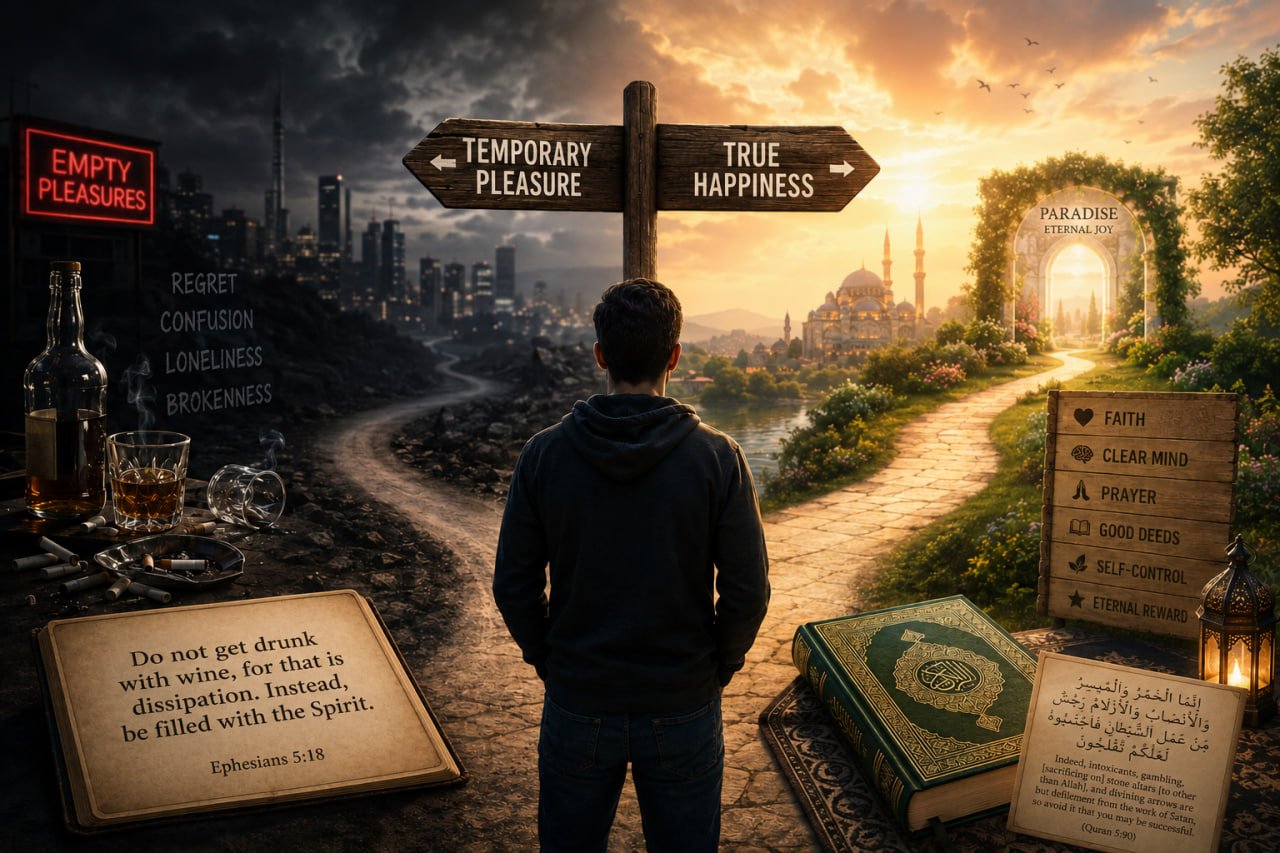
Psychologists often tell us that true happiness is a continuous feeling of contentment and delight. It is the peace of knowing you are on the right path. However, many people fall into the trap of false happiness. This is the temporary high people seek when they are facing and dealing with the stresses of life through substances like alcohol. It feels like a solution, but it is actually a shadow that leaves you in deeper misery once it fades.
♦
The Divine Gift: Preservation of the Intellect
In Islam, one of the greatest objectives of our Sharia is the Preservation of the Mind. Your mind is the tool that allows you to connect with Allah through Tawheed. When we cloud the mind with intoxicants, we are essentially shutting off our connection to the Divine.
Satan wants to stop us from remembering God and prayer. He uses these substances to create enmity and distraction. This is why our beautiful faith protects us by prohibiting that which harms our clarity.
“O you who have believed, indeed, intoxicants, gambling, [sacrificing on] stone altars [to other than Allah], and divining arrows are but defilement from the work of Satan, so avoid it that you may be successful.”
Our beloved Prophet (peace be upon him) taught us clearly about the dangers of these substances. As recorded in the authentic collections:
“Every intoxicant is khamr (wine) and every intoxicant is forbidden.”
Source: Sahih Muslim, Sunnah.com
Scriptural Wisdom: Insights from the Bible
It is very interesting to note that the prohibition of wine and strong drink is not unique to the Quran. The Old and New Testaments contain powerful warnings that align with this preservation of the soul.
- Proverbs 20:1: “Wine is a mocker, strong drink a brawler; and whoever is led astray by it is not wise.”
- Proverbs 23:29-30: Describes those who tarry long over wine as having woe, sorrow, and redness of eyes.
- Galatians 5:19-21: Lists drunkenness as a work of the flesh, warning that those who do such things shall not inherit the kingdom of God.
Even Jesus (peace be upon him) declared in Matthew 26:29 that he would not drink from the fruit of the vine until the day he drinks it new in the Father’s kingdom. This highlights a pivotal turning point in the life of a believer: choosing to give up a temporary, harmful pleasure for something far greater in the hereafter.
Why Do Muslims Quote the Bible if We Do Not Believe It Is Fully Preserved?
Some readers may wonder: “Why quote verses from the Bible if Muslims believe the original revelations were altered over time?”
The answer is simple and important. Muslims believe that Allah originally revealed divine scriptures before the Quran, such as the Torah given to Moses and the Gospel given to Jesus. However, we also believe that human changes and contradictions entered these texts over centuries.
The wisdom behind not preserving the Gospels:
Allah delegated the preservation of the Torah and Gospel to their scholars and monks, based on the evidence of the verse (interpretation of the meaning):
“Verily, We did send down the Torah , therein was guidance and light, by which the prophets, who submitted themselves to Allah’s Will, judged for the Jews. And the rabbis and the priests [too judged for the Jews by the Torah after those prophets], for to them was entrusted the protection of Allah’s Book, and they were witnesses thereto.” [5:44].
Allah did not guarantee to preserve them as He guaranteed to preserve the Quran. There are a number of reasons for this:
1. Allah wanted the Quran to remain the eternal Book and the law that would abide until the Day of Resurrection. Allah says (interpretation of the meaning):
“And We have sent down to you (O Muhammad (peace and blessings of Allah be upon him)) the Book (this Quran) in truth, confirming the Scripture that came before it and Muhaymin (trustworthy in highness and a witness) over it (old Scriptures).” [5:48].
There was no need for the previous Books to be preserved, especially since the time of the Quran was close to the time of the Gospel, and there were only six hundred years between them.
2. That it was to be a test for those who had been given the Book – would they play their role in preserving the Scripture? Would they believe in what it said? Would they follow the Messenger, the Unlettered Prophet, whom they found mentioned in the Torah and Gospel? Or would they persist in their stubbornness and distort, conceal and falsify?
3. This was also a test for all the followers of Christianity until the Day of Resurrection. They can see that the Book in which they believe is not free of distortions, doubts and loss, and they can see that the Book of the Final Messenger Muhammad (peace and blessings of Allah be upon him) has been preserved and transmitted by so many from so many that no one can doubt its authenticity, so that calls them to believe in the clear Book, the Noble Quran.
Yet despite this alteration, many passages still contain remnants of truth and wisdom that agree with the Quran. When Muslims quote such verses, it is not because we consider the Bible completely authentic or equal to the Quran. Rather, it is to show that even within the current Biblical texts there remain teachings that support morality, purity, and the preservation of the soul.
This can also help sincere readers from Christian backgrounds recognize that the call toward righteousness, sobriety, and devotion to God is deeply rooted across revelations.
The Quran itself teaches us this balanced approach:
“And We have revealed to you, [O Muhammad], the Book in truth, confirming that which preceded it of the Scripture and as a criterion over it…”
— Surah Al-Ma’idah 5:48
The Quran is therefore the final criterion: whatever agrees with it from previous scriptures may be acknowledged, and whatever contradicts it is rejected.
The Splendid Reward of the Patient
Many people chase pleasures in this world because they believe they won’t have them later. In contrast, Islam teaches us that whatever we give up for the sake of Allah, He replaces it with something infinitely better.
For the men who lower their gaze and remain chaste avoiding the temptations of adultery and intoxication,
Allah has promised the reward of Al Hur Al’Ayn in Paradise. This is a physical, blissful reality. It is a reward for the discipline shown in this temporary life.
While some other beliefs suggests that in the resurrection people are “as the angels” without marriage (Matthew 22:30), Islam offers a complete fulfillment of human desire in a way that is pure and majestic.
The Reward of Believing Women in Paradise
The mercy and justice of Allah are not limited to men alone. Just as righteous men are promised beautiful rewards in Paradise, believing women are also promised eternal joy, honor, beauty, peace, and complete fulfillment beyond anything imaginable.
Allah says in the Quran:
“Whoever does righteousness, whether male or female, while he is a believer – We will surely cause him to live a good life, and We will surely give them their reward [in the Hereafter] according to the best of what they used to do.”
And Allah also says:
“Allāh has promised the believing men and believing women gardens beneath which rivers flow, wherein they abide eternally, and pleasant dwellings in gardens of perpetual residence; but approval from Allāh is greater. It is that which is the great attainment.”
In Paradise, no believer will feel sadness, jealousy, loneliness, insecurity, or emotional pain. Every righteous woman will receive what delights her heart completely and eternally. Allah, the Creator of every soul, knows perfectly what brings true happiness to His servants.
Paradise is not a place of injustice or deprivation. It is the home of complete satisfaction, purity, love, peace, and everlasting closeness to Allah for both men and women alike.
Do You Seek This True Happiness?
Do not despair if you have struggled in the past. Ask God for help, strive, and keep trying your best. The door of repentance is always open. True happiness is not found in a bottle, but in a heart that is at peace with its Creator.
For more authentic guidance, please visit
IslamQA.info.