
Why Islam Forbids Alcohol:
Mercy, Wisdom, and Protection for Humanity
Islam does not prohibit alcohol to make life difficult. Rather, Allah — the Most Merciful — protects human beings from what destroys the mind, weakens the soul, ruins families, and harms society.
A Religion Built Upon Mercy — Not Hardship
Many people mistakenly think Islam is extremely difficult. But when a believer truly knows his Creator, worship transforms from a burden into peace, purpose, and love.
A believer wakes up for Fajr before sunrise — even in the cold — not because he is forced, but because his heart is connected to Allah.
The believer understands that every sacrifice for Allah carries eternal reward. What may seem difficult at first becomes spiritually beautiful when done sincerely for the Creator.
Allah says:
يُرِيدُ ٱللَّهُ أَن يُخَفِّفَ عَنكُمْ ۚ وَخُلِقَ ٱلْإِنسَـٰنُ ضَعِيفًۭا
“Allah wants to lighten for you [your difficulties]; and mankind was created weak.”
Islam understands human weakness. That is why Allah forbids environments and actions that slowly drag the human being toward destruction — spiritually, mentally, emotionally, and physically.
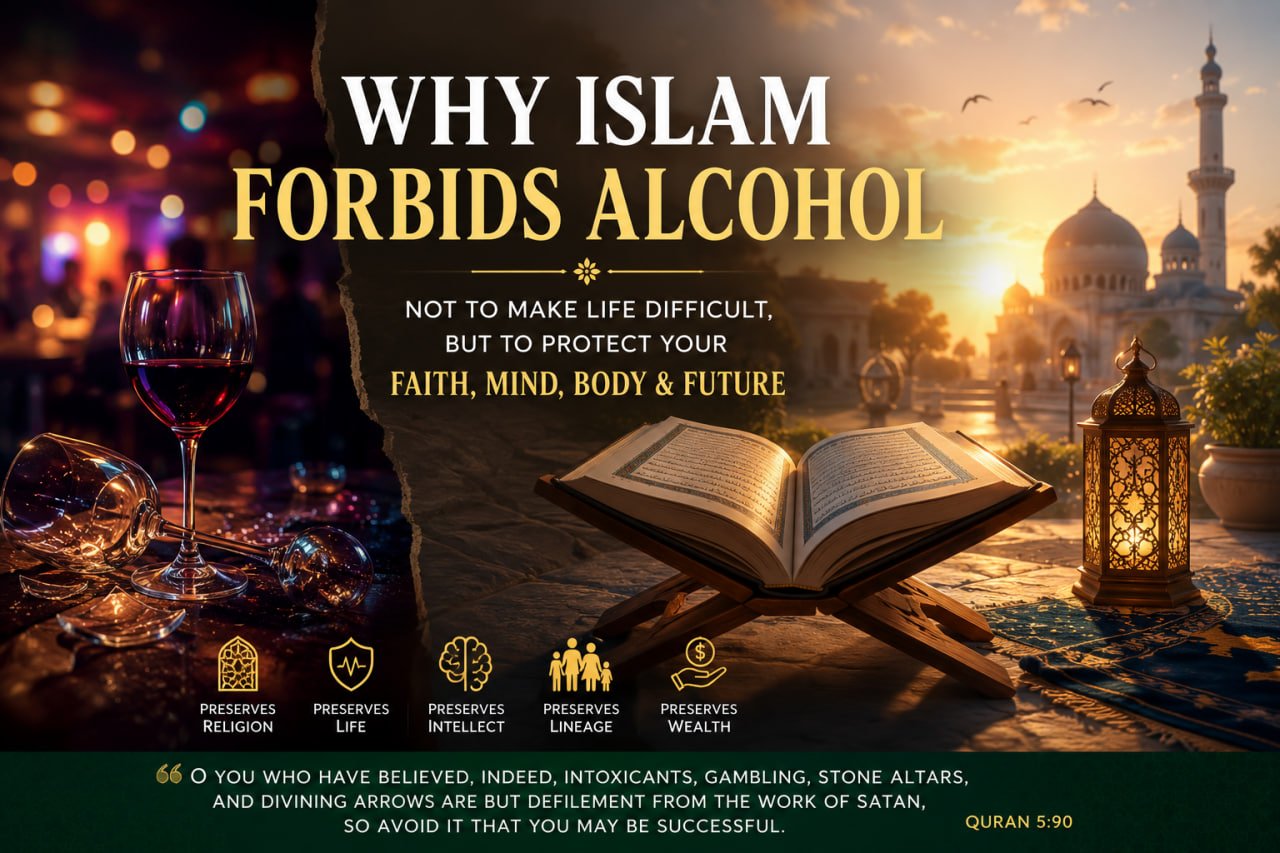
Why Islam Forbids Alcohol
Alcohol is not forbidden in Islam without wisdom. Islam forbids what harms humanity and permits what benefits humanity.
The human intellect is one of the greatest gifts Allah gave mankind. It distinguishes humans from animals. Alcohol clouds judgment, weakens self-control, destroys dignity, and opens the door to violence, abuse, immorality, and regret.
Allah says:
يَـٰٓأَيُّهَا ٱلَّذِينَ ءَامَنُوٓا۟ إِنَّمَا ٱلْخَمْرُ وَٱلْمَيْسِرُ وَٱلْأَنصَابُ وَٱلْأَزْلَـٰمُ رِجْسٌۭ مِّنْ عَمَلِ ٱلشَّيْطَـٰنِ فَٱجْتَنِبُوهُ لَعَلَّكُمْ تُفْلِحُونَ
“O you who have believed, indeed, intoxicants, gambling, stone alters, and divining arrows are but defilement from the work of Satan, so avoid it that you may be successful.”
Notice carefully: Allah did not merely say “do not drink it.” Rather, Allah commanded believers to avoid it entirely.
This includes:
- Drinking alcohol
- Selling alcohol
- Serving alcohol
- Transporting alcohol
- Supporting gatherings centered around alcohol
- Sitting where it is openly consumed
Alcohol Destroys the Foundations of Human Life
Islamic law preserves five universal necessities:
- Preservation of religion
- Preservation of life
- Preservation of intellect
- Preservation of lineage and family
- Preservation of wealth and property
Alcohol directly destroys at least three of these:
- The intellect
- The family
- Human life and safety
Across the world, alcohol contributes to abuse, violence, broken homes, dangerous driving, depression, addiction, and crime.
Why Believers Must Avoid Gatherings of Sin
Islam does not merely prohibit sin itself. Islam also protects the believer from the environments that slowly normalize sin.
A human being is deeply affected by surroundings. What shocks the heart today may become “normal” tomorrow after repeated exposure.
A person who constantly sits around sinful behavior eventually becomes emotionally desensitized to it. Islam protects the believer before spiritual numbness develops.
Avoiding Doubtful and Dangerous Environments
The Messenger of Allah ﷺ said:
“Indeed, the lawful is clear and the unlawful is clear, and between them are doubtful matters which many people do not know. Whoever avoids the doubtful matters clears himself in regard to his religion and his honor…”
This is one of the profound wisdoms behind avoiding gatherings of intoxication, shamelessness, mockery of religion, or open sin.
Allah says:
وَقَدْ نَزَّلَ عَلَيْكُمْ فِى ٱلْكِتَـٰبِ أَنْ إِذَا سَمِعْتُمْ ءَايَـٰتِ ٱللَّهِ يُكْفَرُ بِهَا وَيُسْتَهْزَأُ بِهَا فَلَا تَقْعُدُوا۟ مَعَهُمْ
“And it has already come down to you in the Book that when you hear the verses of Allah denied and ridiculed, do not sit with them…”
Avoiding sinful gatherings is not hatred toward people. Rather, it is protection for faith, the heart, and the family.
How Should a Muslim Respond to a Loved One Who Drinks Alcohol?
Islam encourages wisdom, patience, mercy, and emotional intelligence.
If a loved one struggles with alcohol:
- Advise them gently
- Do not humiliate them publicly
- Pray sincerely for them
- Avoid enabling the sin
- Protect children from exposure
- Avoid sitting with them while alcohol is being consumed
The Prophet ﷺ said:
“There is no kindness in a thing except that it beautifies it, and it is not removed from a thing except that it makes it defective.”
The Prophet ﷺ also said:
“Whoever among you sees an evil action, let him change it with his hand; if he cannot, then with his tongue; and if he cannot, then with his heart — and that is the weakest of faith.”
Why Muslims Sometimes Quote the Bible
Muslims believe that Allah originally revealed scriptures before the Qur’an, including the Torah and Gospel.
However, Muslims also believe these scriptures were altered over time and therefore are not preserved like the Qur’an.
So why do Muslims sometimes quote Biblical passages?
In interfaith discussions and da‘wah, Muslims may cite Biblical passages to show that certain moral teachings — such as avoiding drunkenness — were already condemned in earlier traditions.
This is not because Muslims consider the Bible a final authority over the Qur’an. Rather, it is a way of speaking to people using sources they already recognize.
Does Human Sin Harm Allah?
No. Human obedience does not benefit Allah, and human sin does not harm Allah.
Allah is completely independent and free of need.
إِن تَكْفُرُوا۟ فَإِنَّ ٱللَّهَ غَنِىٌّ عَنكُمْ
“If you disbelieve — indeed, Allah is Free from need of you.”
Sin harms us:
- It darkens the heart
- Weakens faith
- Destroys peace
- Damages families
- Hurts the mind and body
- Distances the soul from Allah
Final Reflection
Islam does not seek to make human life miserable. Every sincere prohibition in Islam is ultimately rooted in wisdom, mercy, protection, and human flourishing.
Allah created the human being weak — and because of His mercy, He guided humanity away from what destroys minds, hearts, families, and societies.
True freedom is not blindly following desires. True freedom is protecting the soul from becoming enslaved to destructive habits.
And when a believer knows his Creator deeply, obedience no longer feels like chains — it becomes light.
Frequently Asked Questions
Why is alcohol forbidden in Islam?
Because it intoxicates the mind, weakens judgment, harms society, and opens doors to many sins and destructive behaviors.
Can Muslims sit where alcohol is being consumed?
Islam discourages believers from sitting in gatherings of open sin because repeated exposure weakens the heart and normalizes evil.
Does our sin harm Allah?
No. Allah is completely independent. Human sins harm the sinner spiritually, emotionally, and socially.
Why do Muslims quote Biblical passages?
In interfaith dialogue, Muslims may cite Biblical passages to communicate moral truths using sources familiar to Christians and Jews.
A note to our Christian friends:
📖 Did Jesus Really Turn Water into Wine?
◆The Bible warns against wine and drunkenness:
Proverbs 20:1: “Wine is a mocker, strong drink is raging; whoever is led astray by it is not wise.”
Ephesians 5:18: “Do not get drunk on wine, which leads to debauchery. Instead, be filled with the Spirit.”
◆Jesus himself rejected drinking wine:
Matthew 26:29: “I tell you, I will not drink from this fruit of the vine from now on until the day when I drink it new with you in my Father’s kingdom.”
◆ Other prophets were also commanded to avoid wine:
Luke 1:15 (about John the Baptist): “He will be great in the sight of the Lord. He must never drink wine or strong drink.”
If John the Baptist was forbidden from it, how could Jesus, produce or consume it?
◆ *The Cana miracle raises a contradiction*:◆
John 2:1–11 claims that Jesus’ first miracle was turning water into wine.
Yet this conflicts with both the biblical prohibition of wine and Jesus’ own words that he would not drink it.
◆ *The Islamic view:* ◆
In Islam, prophets are protected from sin and contradiction.
The Quran never mentions Jesus making or drinking wine. Instead, he is honored as a prophet of purity, wisdom, and devotion to God.
◆ *Conclusion:*
1. This story cannot be authentic, as prophets do not go against God’s commands.
2. This story appears only in the Gospel of John, which raises doubts about how reliable John’s Gospel is in showing the true message and actions of Jesus.