


Women’s Inheritance Rights in Islam:.”

My dear brothers, sisters, and respected truth-seekers across the world — welcome. When we open our hearts and minds to studying divine guidance, we often encounter questions born out of genuine curiosity or honest misunderstanding. One of the most frequently discussed topics in contemporary discourse is the financial status of women in Islam, specifically regarding the laws of inheritance.
At first glance, a person reading the verse, “for the male, what is equal to the share of two females,” might wonder: Does this reflect a disparity in human worth? Today, we shall explore this question with complete academic rigor, heartfelt compassion, and undeniable textual evidence from authentic Islamic sources like IslamQA, Quran.com, and Sunnah.com, alongside comparative legal references.
1. Addressing the Initial Question: Is Inheritance Based on Gender?
The Questioner Asks:
“How can Islam claim justice for women when it gives her half the male’s share in inheritance, as stated in the Qur’an: ‘for the male, what is equal to the share of two females’?”
The Scholarly & Compassionate Response:
To look solely at a single ratio without examining the entire economic infrastructure of Islam leads to a superficial conclusion. Islam granted women absolute, independent financial rights over fourteen centuries ago—rights that women in many Western legal traditions did not acquire until the late 19th and early 20th centuries.
“For men is a share of what they have earned, and for women is a share of what they have earned.”
In the Islamic economic structure, a man bears mandatory financial responsibility (known as Nafaqah) for his wife, his children, his elderly parents, and unmarried female relatives. Allah Almighty explicitly highlights this duty:
“Men are the caretakers of women because Allah has given the one more than the other and because they support them from their means.”
Meanwhile, a woman’s inheritance, earnings, and savings are 100% hers to keep, invest, or spend as she sees fit. She is not legally required to spend a single coin on household expenses, even if she is a millionaire and her husband is poor.
Comparative Perspective: Inheritance in Historical Biblical Law
When examining ancient legal texts such as Numbers 27:8, a woman’s right to inherit was conditional upon the absolute absence of male heirs:
“If a man dies and has no son, then you shall transfer his inheritance to his daughter.” (Numbers 27:8)
Key Legal Takeaway: In that historical framework, a daughter did not inherit if a son was present. Furthermore, under Numbers 36:6–9, a woman’s inheritance was tied to remaining within her father’s tribe, restricting her personal movement of property.
In sharp contrast, the Messenger of Allah ﷺ declared a universal rule establishing guaranteed rights for designated shares:
“Give the shares of inheritance to those who are entitled to them according to the Book of Allah.”
— Narrated in Sahih al-Bukhari & Sahih Muslim
2. The “Half Share Always” Myth: Analyzing 30+ Inheritance Cases
The Follow-Up Questioner Asks:
“Even in cases of inheritance, a disparity remains between male and female. Why does she always receive half in inheritance?”
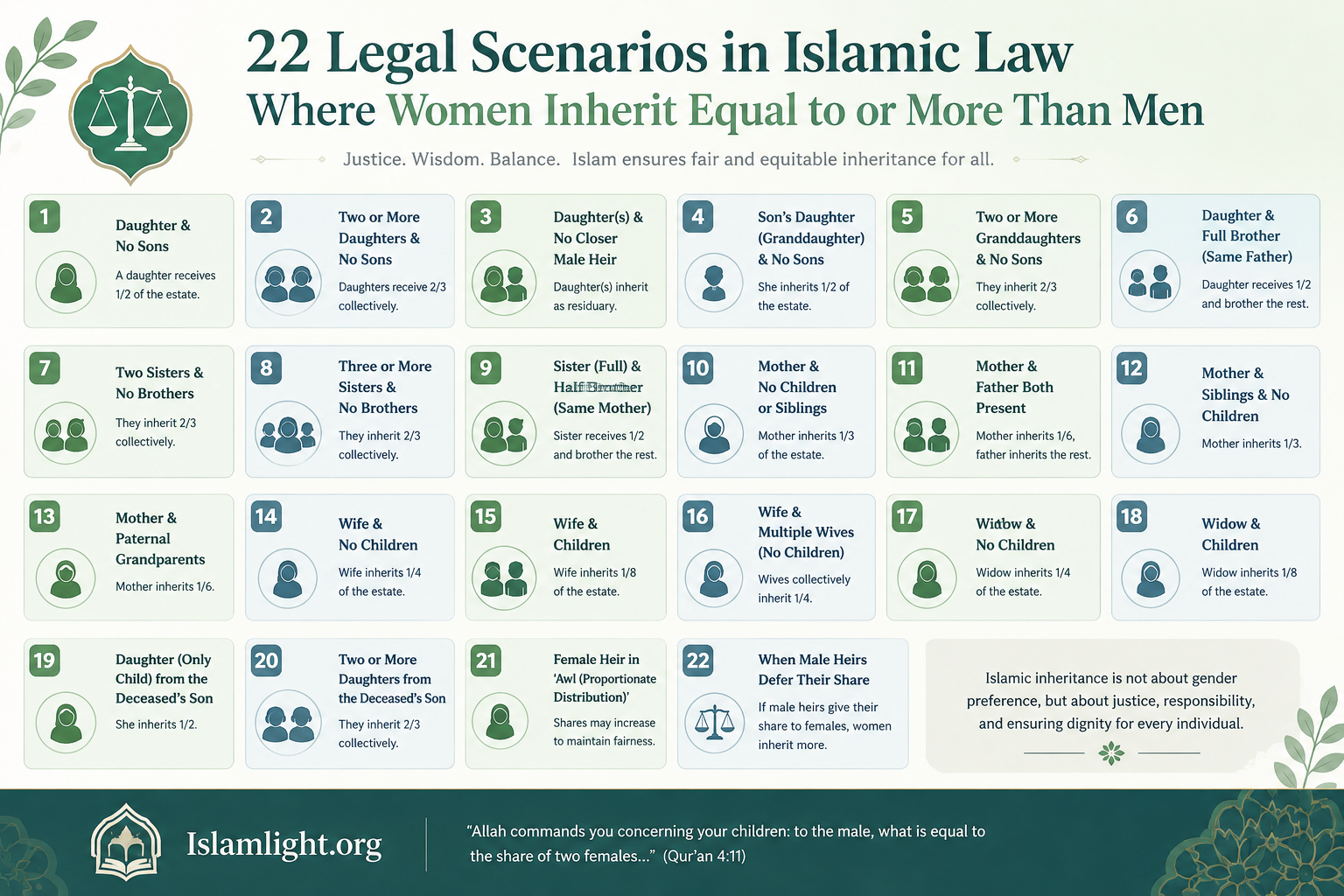
The claim that a woman “always receives half” is factually inaccurate. Comprehensive jurisprudential analysis across Islamic law reveals that there are more than 30 distinct inheritance scenarios. When we categorize them objectively:
Woman receives half of the male’s share
Woman inherits EQUAL to the male
Woman inherits MORE than the male
Woman inherits while male receives NOTHING
Proof of Exact Equality: Mother & Father Inheritance
When a deceased person leaves behind children along with parents, the Quran commands exact numerical equality between mother (female) and father (male):
“And for one’s parents, to each one of them is a sixth of his estate if he should have a child.”
Here, both mother and father receive exactly 1/6th each—zero disparity.
 “
“3. Point-by-Point Comparison: Financial Rights in Islam vs. Historical Biblical Laws
To truly appreciate the revolutionary nature of Islamic financial jurisprudence, let us review a detailed point-by-point comparison grounded in authentic primary sources:
Note to the dear reader: If you are viewing this on a mobile device and the following template appears cut off or does not display correctly, we recommend enabling your phone’s Auto-rotate feature and accessing the site through a web browser. Thanks so much and stay blessed.
| Financial Legal Area | Islamic Jurisprudence (Qur’an & Sunnah) | Historical Biblical Law |
|---|---|---|
| Financial Independence | Full, independent financial identity. Money cannot be taken without her explicit consent. [Surah An-Nisa 4:32] | Vows and financial transactions subject to father’s or husband’s annulment authority. [Numbers 30:3-5] |
| The Marriage Dower (Mahr) | Exclusive gift paid directly to the bride as her sole property. [Surah An-Nisa 4:4] | Bride price paid directly to the father of the bride. [Deuteronomy 22:29] |
| Mandatory Maintenance (Nafaqah) | Strict obligation on the male for food, housing, clothing, and medicine. [Surah Al-Baqarah 2:233] | Historical allowances for selling/indenturing daughters as bondservants. [Exodus 21:7] |
| Protection Upon Divorce | Housing and financial support during Iddah; forbidden to take back past gifts. [Surah At-Talaq 65:6 & An-Nisa 4:20] | Husband gives certificate of divorce and sends her away without long-term legal maintenance. [Deuteronomy 24:1] |
| Firstborn Privilege | Forbidden. All sons and daughters inherit strictly according to divine legal rules. [Sahih al-Bukhari: “Fear Allah & be fair”] | Firstborn male receives double portion over all other siblings. [Deuteronomy 21:17] |
Core Pillars of Financial Equity in Islamic Law
- 1. Three Primary Rules of Allocation: Inheritance shares are determined by three criteria: degree of kinship, generational position (younger generations who have life ahead receive more than older generations), and financial obligation—never by gender.
- 2. Net Savings vs. Gross Expenses: If a brother inherits $100,000, he must pay for housing, food, dower, wife’s expenses, and children’s education. If his sister inherits $50,000, she keeps 100% of it as net savings while her brother or husband continues to pay for her daily food and shelter.
- 3. Absolute Exemption from Blood Money & Liabilities: In cases of unintentional manslaughter where the male relatives (‘Aqilah) are required to contribute financial compensation (blood money), women are completely exempt from paying anything.
- 4. Infinite Safety Net: If a woman is unmarried, widowed, or divorced, her financial care shifts automatically as a legal duty onto her father, brother, son, or nearest male relative. The Prophet ﷺ said: “The one who looks after a widow and a poor person is like a Mujahid in the cause of Allah.” (Sahih al-Bukhari)
4. Thought-Provoking Questions for the Honest Mind
💡
Mathematical Reflection:
Who is in a better financial position: A man who receives $100,000 but is legally forced to spend $100,000 on others, or a woman who receives $50,000 and is legally allowed to keep every single dollar in her private bank account?
⚖️
Systemic Protection Reflection:
Is true equity achieved by burdening women with equal financial expenses, or by honoring them with guaranteed assets while relieving them of all mandatory financial maintenance?