
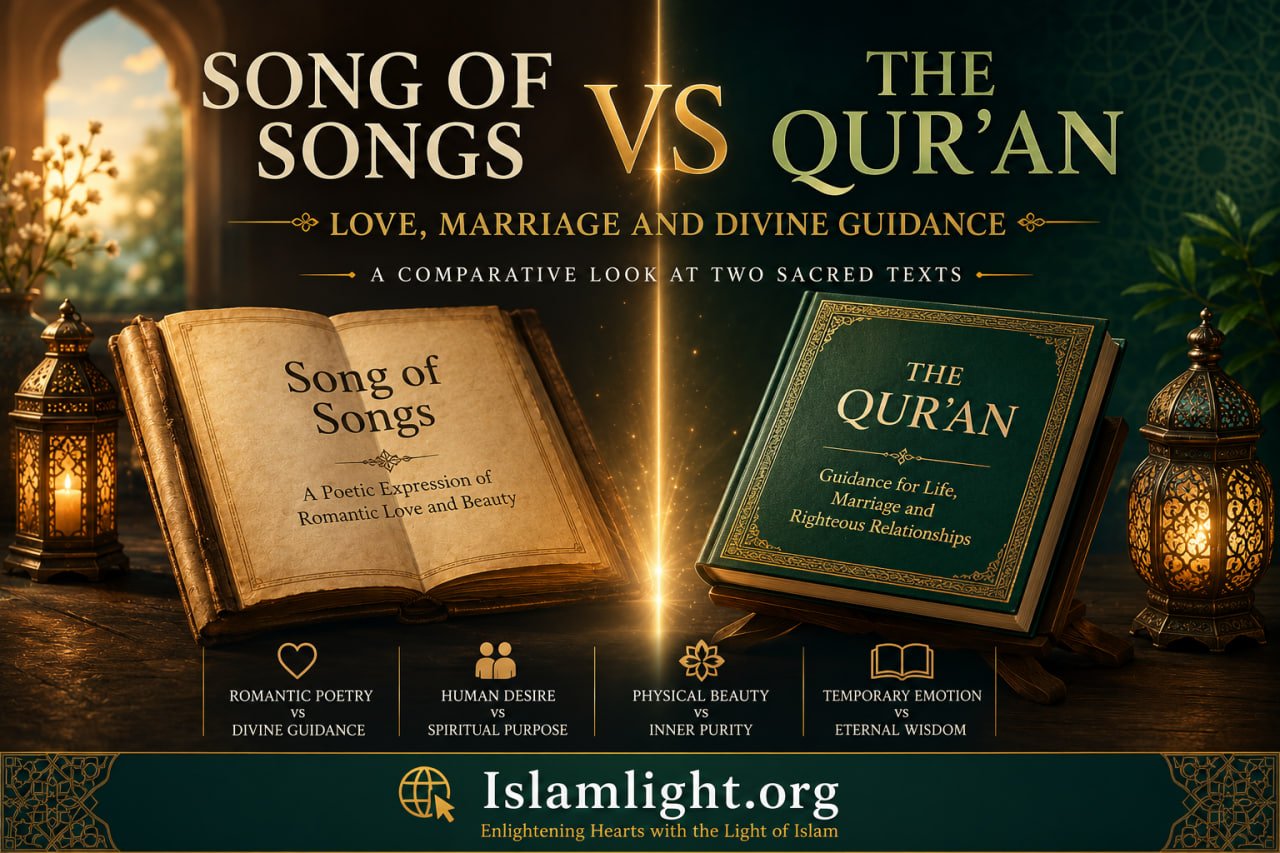

Song of Solomon vs. The Holy Qur’an:
An Exploration of Modesty and Divine Eloquence
Assalamu Alaikum wa Rahmatullahi wa Barakatuhu, my dear brothers, sisters, and respected truth-seekers. Let us embark on a gentle, reflective, and deeply intellectual journey to understand the true hallmark of Divine Revelation.
1. The Quest for True Guidance: What Elements Define the Word of God?
When the Almighty Creator addresses humanity, His words naturally reflect an unparalleled majesty, absolute wisdom, and a profound sense of purity. True scripture serves as a flawless roadmap, a luminous light that elevates human consciousness, shields moral integrity, and provides a peaceful sanctuary for the soul. It is a book that can be read by a grandfather alongside his young granddaughter, filling the room with nothing but reverence and spiritual serenity.
However, when sincere searchers of truth carefully analyze the text known as the Song of Solomon (or the Song of Songs) found within the biblical canon, they often find themselves at a profound crossroads. This text—traditionally attributed to King Solomon in the 10th Century BCE—takes the form of an explicit, deeply descriptive love poem shared between a king and a Shulamite maiden. The sheer intensity and graphic nature of its contents have sparked deep introspection and theological dilemmas across the globe for centuries.
2. Analyzing the Song of Solomon: The Literal vs. Allegorical Escape
Because a literal reading of this text plunges the reader directly into a detailed anatomical exploration of physical forms and passionate desires, theologians have historically sought pathways to interpret these lines outside of their direct textual reality. To comfortably position it within a holy framework, two major allegorical paths were constructed:
- In the Jewish Tradition: The poem was allegorically re-imagined to symbolize the spiritual bond and love between the Almighty and the Children of Israel.
- In the Christian Tradition: The text was adapted to serve as a deep mystical metaphor representing the love between Jesus Christ and the Church.
Yet, when an un-biased, neutral reader approaches the document, they notice that the name of God is virtually absent (mentioned only once conceptually as a minor linguistic suffix in certain historical translations). Instead, the verses remain heavily concentrated on physical attributes and sensual longing. This notable reality leads many comparative text scholars to conclude that the wording mirrors ancient Near Eastern secular wedding songs, rather than divine guidance or legislative prophecy.
3. Textual Realities: A Closer Look at the Verses
To truly understand why these passages cause such severe internal discomfort, let us carefully review a few direct passages from the Van Dyck and King James versions. My beloved friends, consider these lines through the natural lens of pure instinct (Fitrah):
I. Language of Embraces and Intimacy
“Let him kiss me with the kisses of his mouth: for thy love is better than wine… Because of the savour of thy good ointments thy name is as ointment poured forth, therefore do the virgins love thee. Draw me, we will run after thee: the king hath brought me into his chambers…”
— Song of Solomon 1:2-4
II. The Vivid Anatomical Descriptions
“How beautiful are thy feet with shoes, O prince’s daughter! the joints of thy thighs are like jewels, the work of the hands of a cunning workman. Thy navel is like a round goblet, which wanteth not liquor: thy belly is like an heap of wheat set about with lilies. Thy two breasts are like two young roes that are twins.”
— Song of Solomon 7:1-3
“I said, I will go up to the palm tree, I will take hold of the boughs thereof: now also thy breasts shall be as clusters of the vine, and the smell of thy nose like apples; And the roof of thy mouth like the best wine for my beloved, that goeth down sweetly…”
— Song of Solomon 7:8-9
When a sincere heart analyzes these words, an inescapable question arises: Is this the transcendent, timeless communication expected from the Lord of the Worlds to guide humanity toward righteousness, or does it reflect the emotional, passionate output of a human poet expressing earthly desire?
4. The Quranic Paradigm: Elevating Marital Love to Divine Dignity
Now, my beloved friends, let us wash our hearts, quiet our minds, and step into the serene atmosphere of the Holy Qur’an. Observe how the true Lord of the Universe addresses the highly intimate relationship between a husband and wife. The Qur’an never seeks to detail physical anatomy or provoke human instincts. Instead, it frames the marital bond with breathtaking modesty (Haya’), shifting the focus entirely to peace, respect, protection, and spiritual elevation.
A Foundation Built on Peace and Compassion
«وَمِنْ آيَاتِهِ أَنْ خَلَقَ لَكُم مِّنْ أَنفُسِكُمْ أَزْوَاجًا لِّتَسْكُنُوا إِلَيْهَا وَجَعَلَ بَيْنَكُم مَّوَدَّةً وَرَحْمَةً»
“And of His signs is that He created for you from yourselves mates that you may find tranquility in them; and He placed between you affection and mercy. Indeed in that are signs for a people who give thought.”
The Concept of Mutual Comfort, Protection, and Style
«هُنَّ لِبَاسٌ لَّكُمْ وَأَنْتُمْ لِبَاسٌ لَّهُنَّ»
“…They are clothing for you and you are clothing for them…”
[Verify via Sahih International – Surah Al-Baqarah 2:187]
Linguistic Depth: What an incredible description! The word “Libas” (clothing) wraps the relationship in layers of profound meaning. Clothing provides warmth, shields your secrets, conceals your flaws, protects you from worldly harms, and beautifies your appearance. This is how the Almighty describes a spouse, without needing to list body parts.
Conjugal Relations Addressed with Sublime Modesty
«فَلَمَّا تَغَشَّاهَا حَمَلَتْ حَمْلًا خَفِيفًا»
“And when he had covered her, she carried a light burden and continued therein…”
[Verify via Sahih International – Surah Al-A’raf 7:189]
Linguistic Depth: SubhanAllah! The single phrase “covered her” (Arabic: Taghashaha) captures the complete physical meeting of husband and wife in perfect clarity. Yet it is phrased so purely that a child learning the book of Allah remains completely protected from any loss of innocence.
5. The Wisdom of the Sunnah: Modesty is the Hallmark of Faith
This divine standard of purity is fully upheld and detailed within the authentic teachings of our beloved Prophet Muhammad ﷺ. He consistently taught us that true faith and modesty are permanently intertwined. When modesty is preserved, our speech, writing, and thoughts remain fundamentally pure.
“Abu Hurairah narrated that the Messenger of Allah (ﷺ) said: ‘Faith has seventy-odd branches, and modesty (Al-Haya’) is a branch of faith.'”
“Anas bin Malik narrated that the Messenger of Allah (ﷺ) said: ‘Every religion has its distinct characteristic, and the distinct characteristic of Islam is modesty. (Al-Haya’).'”
6. The Practical Litmus Test: We Have No Texts We Must Hide!
My dear brothers and sisters, let us reflect honestly with our natural intellect. There is an incredibly powerful real-world test that separates transient human writing from pristine, uncorrupted Divine Revelation: The Test of Universal Recitation.
As Muslims, we carry the immense blessing of possessing a book where every single letter is pure, every single verse carries absolute dignity, and every single chapter overflows with spiritual light. Because of this, we live with beautiful realities that no other nation can duplicate:
- Recitation in All Life’s Milestones: We proudly read the Qur’an during our most joyful wedding banquets to ask for blessings. We loudly and beautifully read the exact same book during our most difficult funeral ceremonies to grant comfort, serenity, and remembrance of Paradise to grieving hearts.
- Openly Shared with Our Children: We do not have any secret chapters. We do not have texts restricted to specific age groups, marked “+18”, or kept safely away from the innocent eyes of children. We teach the book of Allah to our kids in nurseries and schools from their earliest years, building a foundation of refined manners, modesty, and linguistic beauty.
Let us ask an honest, critical question: Would any teacher feel comfortable standing in front of an elementary school classroom to analytically explain the literal descriptions of thighs, navels, and breasts found in Song of Solomon Chapter 7? Would anyone choose to read those specific romantic exchanges during a funeral procession to bring peace to a grieving family? The natural human instinct (Fitrah) instantly shouts: “No!”
This basic reality is the ultimate proof. Human writing can be heavily influenced by physical passions, secular traditions, and historical distortions. But the true word of the Almighty remains a pristine source of guidance (Huda) and cure (Shifa’) across all times, places, and situations. Authentic Islamic reference platforms, including IslamQA, beautifully remind us that this preservation is the direct realization of God’s promise to keep His text unpolluted from human modifications.