
The Remarkable Preservation of the Qur’an
Suppose someone claimed to possess the final revelation from the Creator of the universe. One question would naturally follow:
Has that revelation truly been preserved?
This question is not merely academic.
If God intended His final guidance for all of humanity until the end of time, then preserving that guidance would be essential.
A message that became corrupted, lost, or continuously rewritten could no longer serve as a reliable foundation for faith.
Remarkably, this is one of the areas in which Islam presents one of its strongest historical claims.
The Qur’an recited by Muslims throughout the world today is the same Qur’an recited by Prophet Muhammad ﷺ over fourteen centuries ago.
A Divine Promise of Preservation Unlike any statement made by human authors, the Qur’an contains an explicit promise regarding its own preservation.
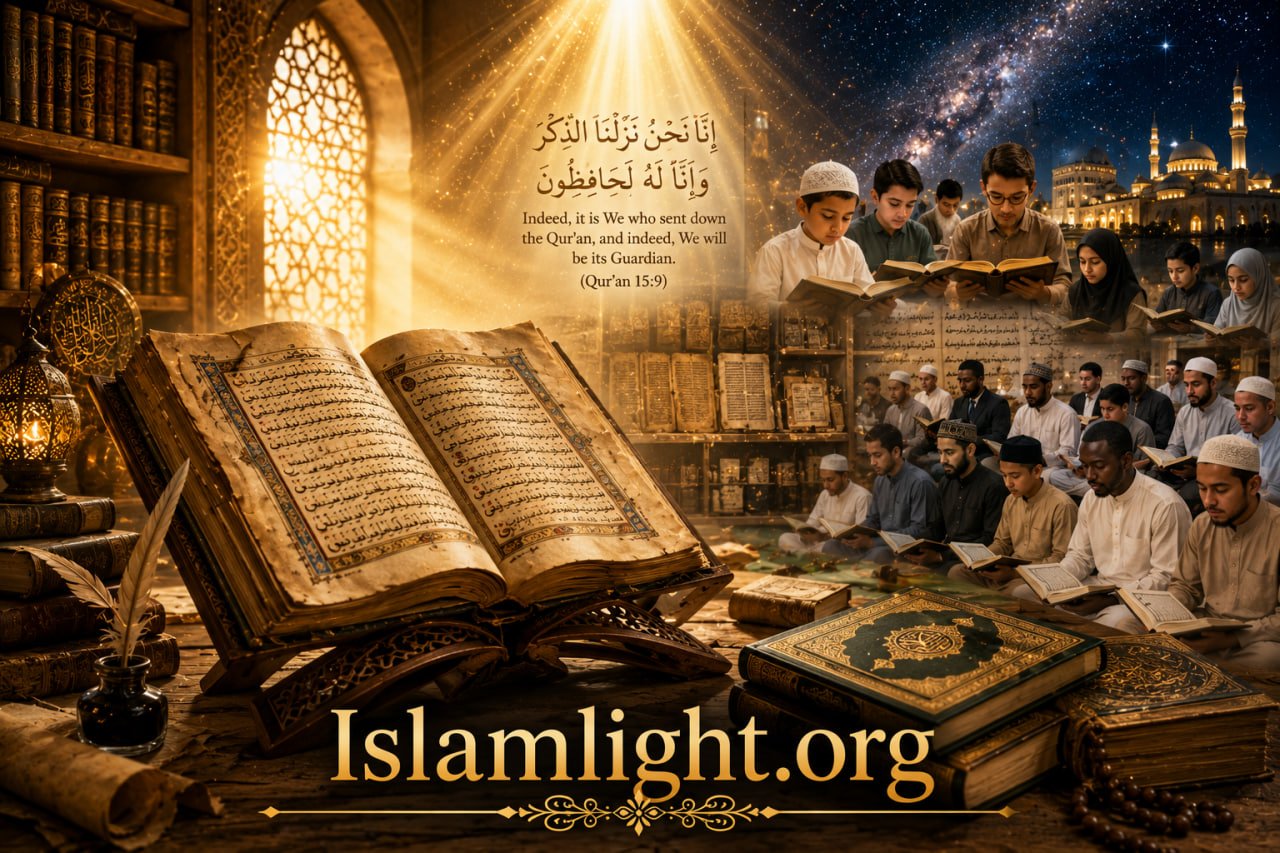
Qur’an — Surah Al-Hijr (15:9)
“Indeed, it is We who sent down the Qur’an, and indeed, We will be its Guardian.”
Sahih International Translation
https://quran.com/15/9?translations=20
For Muslims, this verse is far more than a comforting statement.
It is a divine guarantee.
If the Qur’an had disappeared, become irretrievably corrupted, or existed today only through conflicting versions, critics could rightly question this promise.
Instead, history presents an extraordinary picture of preservation unlike that of any other major religious scripture.
A Revelation Preserved by Hearts Before Books One of the most unique characteristics of the Qur’an is that it was preserved not only in written form but also in the memories of thousands of people. From the earliest days of Islam, the Prophet ﷺ encouraged his Companions to memorize every verse as it was revealed. Many devoted their lives to learning the Qur’an by heart. This tradition has continued uninterrupted for more than fourteen centuries. Today, millions of Muslims_including young children_have memorized the entire Qur’an from beginning to end. They live on every inhabited continent and speak hundreds of different native languages, yet they recite exactly the same Arabic text.
A Remarkable Thought Experiment
Imagine that every printed copy of the Qur’an disappeared tomorrow.
Would the Qur’an be lost?
No.
Because millions of people have memorized it in its entirety, it could be rewritten from memory with extraordinary precision.
Very few books in human history have ever been preserved in this way.
Writing During the Prophet’s Lifetime The Qur’an was not left solely to oral transmission. Whenever revelation descended, the Prophet ﷺ instructed trusted scribes to write the verses immediately. Among these scribes was Zayd ibn Thabit رضي الله عنه, together with several other Companions. The Prophet ﷺ also directed where each newly revealed passage belonged within the chapters of the Qur’an. Thus, the Qur’an was simultaneously preserved through memorization and careful writing during his own lifetime. After his passing, the first Caliph, Abu Bakr رضي الله عنه, commissioned an official compilation of the written materials under the supervision of those who had memorized the Qur’an directly from the Prophet ﷺ. Later, during the caliphate of Uthman ibn Affan رضي الله عنه, authenticated copies were distributed to the major regions of the Muslim world to preserve a unified written text. This careful process was undertaken with transparency and consultation among the Prophet’s Companions.
The Qur’an Invites Verification One of the remarkable qualities of the Qur’an is that it repeatedly invites readers to think, reflect, and verify rather than accept blindly. For example, it openly challenges those who doubt its origin to examine whether its contents contain internal contradiction.
Qur’an — Surah An-Nisa (4:82)
“Then do they not reflect upon the Qur’an? If it had been from anyone other than Allah, they would have found within it much contradiction.”
Sahih International Translation
https://quran.com/4/82?translations=20
Rather than discouraging examination, the Qur’an encourages thoughtful engagement.
It appeals to reason, inviting readers to study its message carefully and honestly.
More Than Preservation of Words The preservation of the Qur’an extends beyond its wording. Its recitation has also been transmitted through carefully preserved chains of qualified teachers and students. For centuries, Muslims have learned the Qur’an directly from certified instructors who themselves learned from earlier teachers, creating an unbroken chain tracing back to the Prophet ﷺ. This living tradition combines written manuscripts with oral transmission, providing an additional layer of preservation. It is not merely a historical artifact placed on a shelf. It is a living revelation recited daily in prayers across the globe.
An Invitation to Every Reader
Whether one approaches the Qur’an as a believer, a skeptic, or simply a curious reader, it deserves to be examined firsthand.
Read it thoughtfully.
Reflect upon its message.
Ask difficult questions.
Compare its teachings with its historical preservation.
A sincere search for truth begins not with assumptions but with careful investigation.
The Qur’an’s Enduring Impact Generation after generation, the Qur’an has inspired individuals to abandon injustice, addiction, hatred, and despair in favor of faith, integrity, compassion, and purpose. Its influence cannot be measured merely by the number of printed copies in circulation. Its true preservation is witnessed in the millions of hearts that continue to recite it, live by it, and teach it to future generations. For Muslims, this remarkable continuity is not an accident of history. It is the fulfillment of Allah’s promise to preserve His final revelation until the end of time.
“The Qur’an is not merely a book preserved in libraries. It is a revelation preserved in hearts, recited on tongues, written in manuscripts, and lived by millions around the world.”
✅✅✅
The next chapter, by Allah’s will, grace and mercy, will explore another important area of discussion: the relationship between Islam and the earlier revelations given to prophets such as Abraham, Moses, and Jesus (peace be upon them all), and why Muslims believe Islam is not a new religion but the completion of the same timeless message.