
Islam: The Completion of the Divine Message
One of the misconceptions about Islam is the belief that it introduced an entirely new religion in the seventh century.
In reality, Islam teaches something profoundly different.
According to the Qur’an, the message preached by Prophet Muhammad ﷺ was not a new religion but the continuation and completion of the same timeless message revealed to every prophet before him.
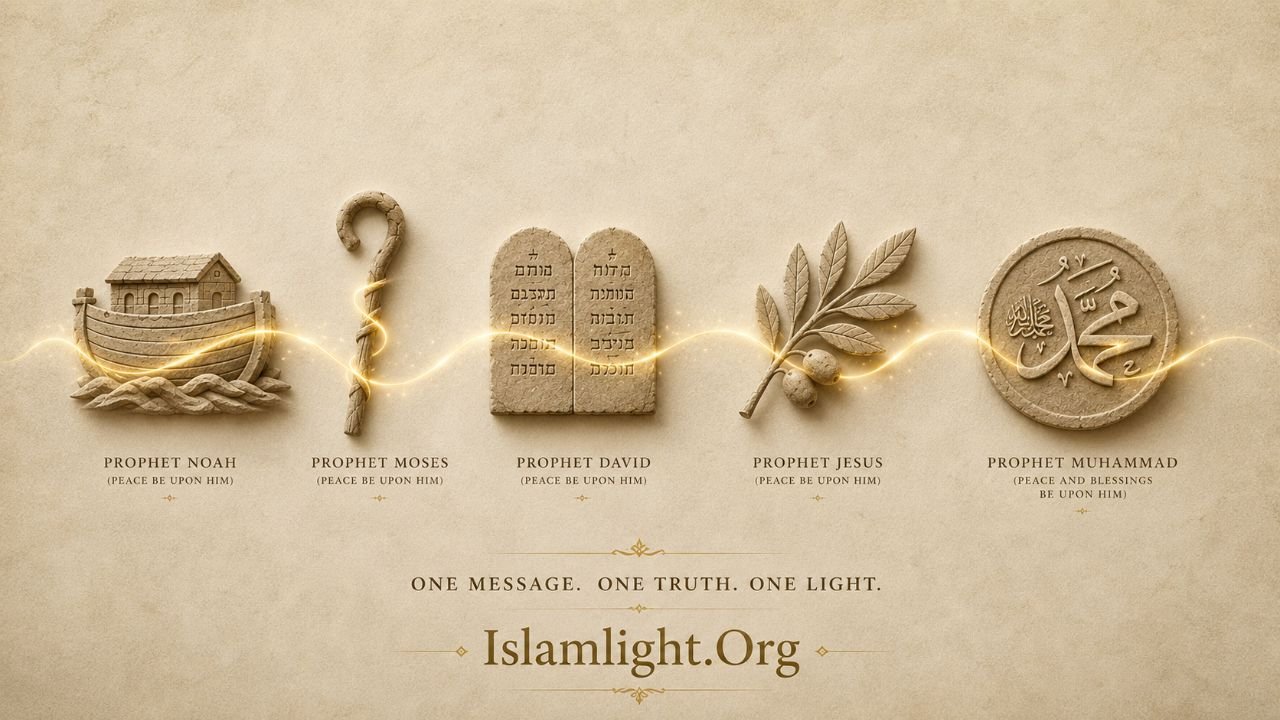
From Adam to Noah…
From Abraham to Moses…
From David to Jesus…
The central call remained unchanged:
Worship the One True God alone and follow His guidance.
While laws given to different communities sometimes differed according to their circumstances, the foundation of faith never changed.
One Message, Many Prophets
The Qur’an repeatedly emphasizes that Allah sent messengers to every nation throughout history.
These prophets did not compete against one another.
Rather, they formed one continuous chain of revelation.
Each prophet confirmed those who came before him and prepared people for those who would follow.
Qur’an — Surah An-Nahl (16:36)
“And We certainly sent into every nation a messenger, saying, ‘Worship Allah and avoid false gods.'”
Sahih International Translation
https://quran.com/16/36?translations=20
This verse reveals a remarkable unity across human history.
Although prophets lived in different lands, spoke different languages, and addressed different societies, they all called people to the worship of the same Creator.
Islam therefore teaches respect for every genuine prophet sent by Allah.
Rejecting one prophet while accepting another contradicts this unified message.
Muslims Believe in Jesus and Moses
Many people are surprised to learn that belief in Jesus (peace be upon him) and Moses (peace be upon him) is an essential part of Islamic faith.
A Muslim cannot be considered a believer while denying any prophet whom Allah truly sent.
The Qur’an praises many prophets by name and recounts their struggles, miracles, patience, and unwavering trust in Allah.
Jesus is mentioned in the Qur’an more than twenty times by name, and an entire chapter is named after his noble mother, Mary (Maryam), who is honored as one of the greatest women in history.
However, while Muslims deeply love and respect Jesus, they worship only the One who sent him.
Qur’an — Surah Al-Baqarah (2:136)
“Say, ‘We have believed in Allah and what has been revealed to us and what was revealed to Abraham, Ishmael, Isaac, Jacob and the Descendants, and what was given to Moses and Jesus and what was given to the prophets from their Lord. We make no distinction between any of them, and we are Muslims [submitting] to Him.'”
Sahih International Translation
https://quran.com/2/136?translations=20
Why Was Another Messenger Needed?
If prophets had already been sent before Muhammad ﷺ, why was there a need for another messenger?
Islam answers this question in two complementary ways.
First, previous prophets were generally sent to specific communities during particular periods of history.
Their missions addressed the needs of those people.
Second, Muslims believe that the original revelations given to earlier prophets were not all preserved in their complete original form.
While the Qur’an acknowledges the divine origin of previous revelations such as the Torah and the Gospel, it also teaches that changes occurred over time through interpretation, omission, or textual alteration.
For this reason, Allah sent His final Messenger ﷺ with the Qur’an_a revelation preserved for all humanity until the end of time.
The Completion of the Religion
Near the end of the Prophet Muhammad’s ﷺ life, one of the most significant verses of the Qur’an was revealed during the Farewell Pilgrimage.
This verse announced that Allah had completed His religion and perfected His favor upon the believers.
Qur’an _ Surah Al-Ma’idah (5:3)
“This day I have perfected for you your religion and completed My favor upon you and have approved for you Islam as religion.”
Sahih International Translation
https://quran.com/5/3?translations=20
This verse carries profound significance.
It does not merely mark the completion of the Prophet’s ﷺ mission.
It declares that the guidance necessary for humanity’s relationship with Allah had been completed.
No new prophet would be needed after him.
No new revelation would supersede the Qur’an and the sunnah.
The chain of prophethood had reached its divinely intended conclusion.
What About Earlier Scriptures?
Some readers naturally wonder whether Muslims believe the Bible contains truth.
The Islamic answer is balanced and nuanced.
Muslims affirm that Allah revealed scripture to earlier prophets.
However, Islam also teaches that not everything contained within the existing biblical manuscripts necessarily represents the exact original revelation.
Consequently, Muslims use the Qur’an as the final criterion by which previous religious claims are evaluated.
Where earlier scriptures agree with the Qur’an, Muslims readily affirm that truth.
Where they clearly contradict the Qur’an regarding essential matters of belief, Muslims understand that such differences do not represent the original revelation given by Allah.
This approach allows Muslims to honor previous prophets while preserving the integrity of the final revelation.
A Note About Biblical Prophecies
Many Muslim scholars have discussed passages such as Isaiah 42, Deuteronomy 18, and Psalm 84 as possible references to the coming of Prophet Muhammad ﷺ. These discussions form an important part of Islamic apologetics and comparative religion.
For this reason, this article encourages readers to examine these passages directly, compare the different perspectives fairly, and evaluate the evidence with intellectual honesty.
A Universal Invitation
Islam’s message is not addressed to one race, one tribe, one language, or one nation.
Its invitation extends to every human being.
Regardless of background, culture, or previous beliefs, every person is invited to know the Creator directly, without intermediaries, and to worship Him alone.
This universal call distinguishes the final message of Islam and reflects the mercy of Allah toward all humanity.
“The prophets were many, but their Lord was One. Their languages differed, their peoples differed, yet their message remained beautifully consistent: Worship Allah alone and follow His guidance.”