
A compassionate look into divine tests, historical continuity, and the true meaning of spiritual inheritance in the Holy Land.
📋 Key Insights in This Article
- 1. The Common Lineage of Faith: Clearing Misconceptions
- 2. Scriptural Preservation and the Textual Legacy
- 3. Examining the Genesis Promise: Who Inherited the Legacy?
- 4. Surah Al-Ma’idah & The Conditional Nature of Divine Assignment
- 5. The Law of Righteousness: Eternal Inheritance Belongs to the Faithful
My dear brothers, sisters, and truth-seekers, welcoming questions about sacred geography is a beautiful part of seeking understanding. Few regions carry the spiritual weight, reverence, and historical intrigue of Palestine _the land walked by noble Prophets, blessed by divine revelations, and cherished by generations. To truly understand who holds stewardship over this sacred sanctuary, we must turn our hearts and minds to divine scripture, historical facts, and authentic classical commentary.
1. The Common Lineage of Faith: Clearing Misconceptions
When we examine history through a divine lens, we notice a recurring human tendency: claiming exclusive ownership over universal messengers of God. Allah Almighty addresses this directly in the Glorious Quran, reminding humanity that the noble Prophets were not defined by modern political or sectarian labels, but by their total submission to the One Creator.
“Or do you say that Abraham and Ishmael and Isaac and Jacob and the Descendants were Jews or Christians? Say, ‘Are you more knowing or is Allah?’ And who is more unjust than one who conceals a testimony he has from Allah? And Allah is not unaware of what you do.”
All the noble Prophets_ from Abraham to Ishmael, Isaac, Jacob, Moses, Jesus, and Muhammad (peace be upon them all)_ brought one unifying message: monotheism, justice, and devotion. To claim them exclusively under late sectarian definitions contradicts both scriptural history and divine revelation.
2. Scriptural Preservation and the Textual Legacy
Authentic Islamic tradition teaches us to respect the original scriptures given to Moses (the Torah) and Jesus (the Gospel). However, history and divine revelation both attest that over time, human interpolation altered these texts, leading to distorted claims surrounding divine covenants.
“So for their breaking of the covenant We cursed them and made their hearts hardened. They distort words from their [proper] places…”
Because historical texts suffered alterations, any claim derived from modified documents must be weighed against authentic divine revelations and verified historical logic.
3. Examining the Genesis Promise: Who Inherited the Legacy?
Even if one were to analyze the Old Testament narrative on its own terms, a critical chronological detail emerges regarding the Abrahamic promise. Scripture notes that God made a promise to Abraham (peace be upon him) upon entering Canaan and across several occasions recorded in Genesis (e.g., Genesis 12:7, Genesis 13:15, Genesis 15:18, Genesis 17:8).
Crucially, during these initial promises, Ishmael (peace be upon him) was Abraham’s eldest and only living son. Isaac (peace be upon him) was not yet born. Therefore, if the promised seed is understood through direct lineage, Ishmael_ the great-grandfather of the Arab nation and Prophet Muhammad ﷺ _ holds an undeniable claim to that ancestral blessing.
“He never made any unconditional promise that the possession would be eternal, although the intention was a long and unspecified period.”
4. Surah Al-Ma’idah & The Conditional Nature of Divine Assignment
A central point often brought up in comparative study is the verse where Prophet Moses (peace be upon him) addresses his people:
“And [mention, O Muhammad], when Moses said to his people, ‘O my people, remember the favor of Allah upon you when He appointed among you prophets and made you possessors and gave you that which He had not given anyone among the worlds. O my people, enter the blessed land [i.e., Palestine] which Allah has assigned to you and do not turn back [from fighting in Allah’s cause] and [thus] become losers.'”
Classical Quranic commentators (such as Ibn Kathir and Al-Qurtubi) emphasize that this divine assignment was conditional, not absolute or eternal. It was bound to their faith, patience, and obedience to God at that specific era in history when they represented the believers on Earth.
- Historical Realization: The fulfillment of this entry occurred under the leadership of Yusha ibn Nun (Joshua, peace be upon him) after the 40 years of wandering in the wilderness, continuing through the righteous reigns of David and Solomon (peace be upon them).
- The Universal Spiritual Rule: When communities broke their covenants, rejected the Prophets, and caused corruption, the privilege of divine guardianship was revoked.
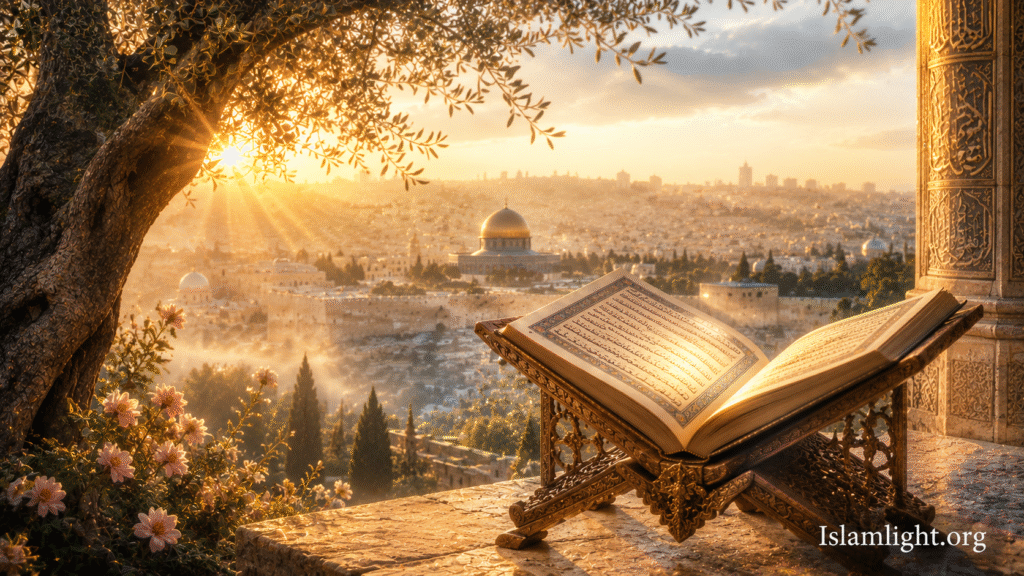
5. The Law of Righteousness: Eternal Inheritance Belongs to the Faithful
Islam presents a clear, ethical principle regarding sacred land: land belongs to God, and He grants stewardship over its holy sites to those who worship Him sincerely and uphold righteousness.
“And We have already written in the book [of Psalms] after the [previous] mention that the land [of Paradise/blessed earth] is inherited by My righteous servants.”
📖 Authentic Sunnah Reference
The Prophet Muhammad ﷺ emphasized the sanctity of Al-Aqsa Mosque and Palestine, reminding us of its deep spiritual connection to all believers: “Do not undertake a journey (with special intention) except to three mosques: Al-Masjid Al-Haram, this Mosque of mine (in Madinah), and Al-Masjid Al-Aqsa.”
— Verified Reference on Sunnah.com (Sahih al-Bukhari 1189)
Land stewardship in Islam is never a matter of tribal privilege or physical lineage alone; it is a spiritual trust (Amanah). For over fourteen centuries, Muslims have honored, protected, and preserved the sacred heritage of Palestine for all peaceful inhabitants and pilgrims of faith.
A Final Reflection for the Truth-Seeker
When we trace history, scripture, and divine covenants with an open heart, the answer becomes clear. Palestine is a sacred trust meant for those who uphold monotheism, justice, and compassion. May Almighty Allah grant us beneficial knowledge, soften our hearts toward truth, and bless the holy land of Palestine with enduring peace, justice, and protection.