
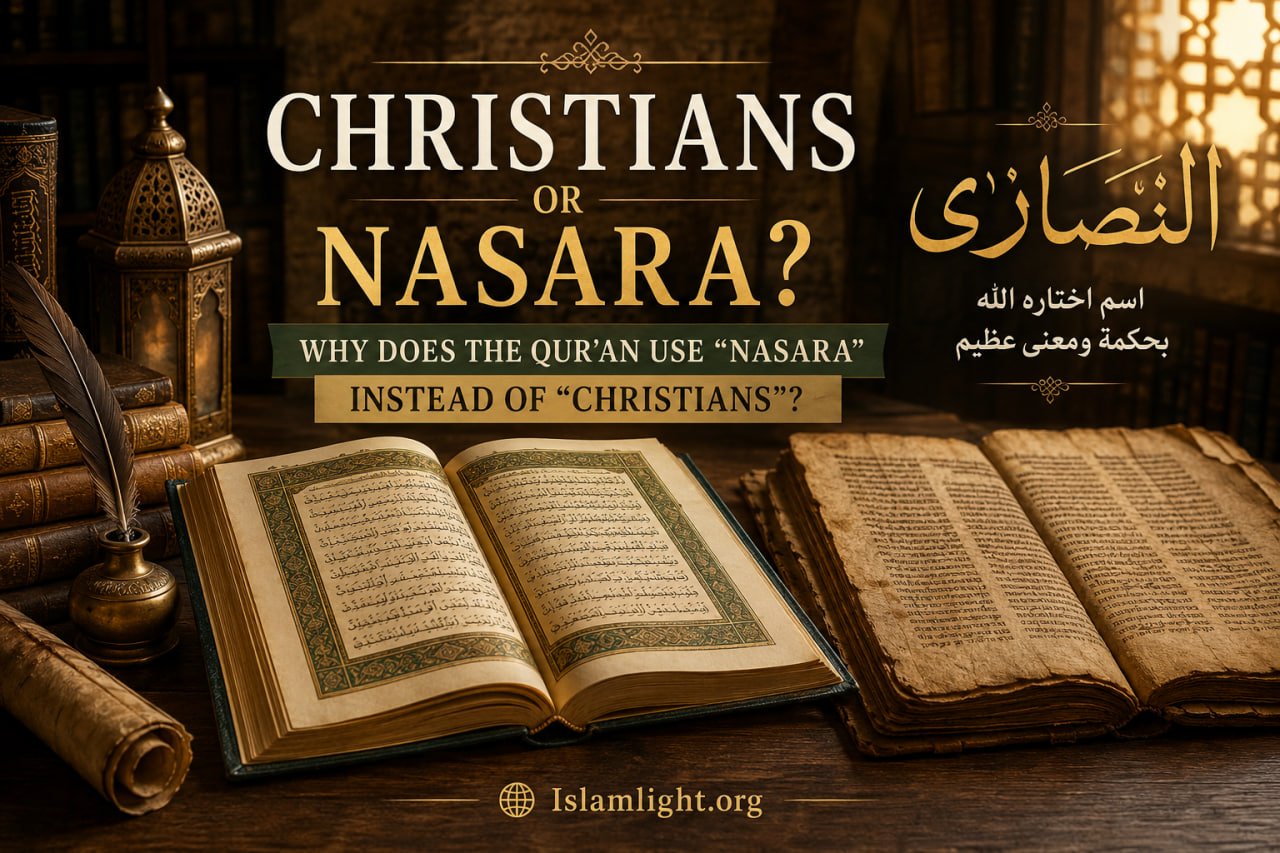

Why Does the Quran Call Christians “Nasara”?
Unveiling the Hidden History of Divine Designations Versus Human Labels
My beloved brothers, sisters, and respected truth-seekers, words are beautiful gifts from the Almighty. They hold keys to our identity, our history, and our understanding of the divine message. In our modern, fast-paced world, we frequently use popular socio-religious titles without ever stopping to contemplate where they truly originated, what deep histories they carry, or what theological weights they bear.
A fascinating question often arises among academic circles and everyday Muslims alike:
Why does the Holy Quran consistently address the followers of the Messiah, Prophet Jesus (peace be upon him), with the specific, sacred title of “Nasara” (نصارى)?
Why do we, when attempting to align ourselves with contemporary trends or secular modernism, deliberately substitute this textually rooted title with the human-fashioned descriptor “Christian”? Is it a harmless linguistic preference, or does this simple choice of words hide a deep, foundational difference in creed, history, and paradigm?
Let us step back together in time, with open hearts, soft minds, and a mutual love for authentic truth, to dissect the detailed history of these two titles. By examining early biblical history, classical Arabic linguistics, and authentic Islamic records, we will reveal how the Quranic terminology acts as a powerful reminder of pure, uncompromised monotheism.
1. The Origin of “Christian”: A Label Constructed by Outsiders
To build an accurate, objective understanding, we must look directly into the historical and scriptural landscape of early Christendom. If one meticulously explores the pages of the New Testament Gospels or searches the biographical details of Prophet Jesus (ʿĪsā ibn Maryam), a striking fact emerges: **the word “Christian” was completely absent during his dynamic Earthly ministry.**
Prophet Jesus never gathered his disciples together to tell them they were creating a brand-new religion called “Christianity,” nor did his early devoted followers style themselves under that name. Rather, historical texts show us that this term was generated entirely outside of divine revelation. The exact moment of its birth is preserved clearly in biblical history:
“…And the disciples were first called Christians in Antioch.”
— The Holy Bible, Acts 11:26
This text reveals that the title emerged many decades after the noble ascension of Prophet Jesus. More importantly, it was not formulated by the community of believers themselves. The linguistic root of the word—the Latinized Greek term Christianoi—was originally coined and cast upon them by the **pagan Roman authorities and citizens of Antioch**.
In the ancient socio-political climate of the Roman Empire, the linguistic suffix -iani carried a mocking, factional connotation. It was used to classify marginalized political groups or the fanatical devotees of controversial figures. To the pagan Roman mindset, the crucifixion of any individual was the ultimate mark of public humiliation, shame, and societal defeat.
Therefore, when the Romans labeled this community as “Christians,” it was often intended as a public, biting insult. It effectively translated to: *“Those strange followers of that humiliated, executed figure.”* Over several centuries, as the Roman Empire transformed its political machinery and eventually absorbed this community, what was once a mocking street insult gradually shifted into an established official identity and a badge of theological pride.
2. The Title “Nasara”: A Precision-Crafted Divine Designation
While human labels are shaped by evolving cultural conflicts, the vocabulary of the Holy Quran is structurally perfect and timeless. God Almighty chooses names that expose the spiritual core and true history of human groups. The Quran consistently places this historical group into a clear theological framework using the word **Nasara**.
وَقَالَتِ الْيَهُودُ لَيْسَتِ النَّصَارَىٰ عَلَىٰ شَيْءٍ وَقَالَتِ النَّصَارَىٰ لَيْسَتِ الْيَهُودُ عَلَىٰ شَيْءٍ وَهُمْ يَتْلُونَ الْكِتَابَ…
“The Jews say ‘The Christians have nothing to stand upon,’ and the Christians say ‘The Jews have nothing to stand upon,’ although they both recite the Scripture…”
According to the classical analytical legacy of Islamic scholarship—as verified on leading platforms of jurisprudence like
IslamQA (see Fatwa 69746)—the divine choice of the word *Nasara* is grounded in two beautifully sound linguistic and historical streams:
The primary linguistic school highlights that the term represents a clear geographical link to the historically vibrant town of al-Nasirah (Nazareth), nestled in the rolling hills of Palestine. This is the very town where Prophet Jesus (ʿĪsā) was raised, where his family resided, and where his initial public announcements of God’s message echoed out. Thus, it roots their name in the historical, physical geography of the Middle East rather than the socio-political movements of the far-off Roman Empire.
The second, deeply inspiring linguistic view states that the word springs directly from the Arabic root noun Nusrah (نصرة), which denotes aid, fierce defense, and loyal assistance for the truth. It immortalizes the profound, history-altering spiritual pact made by the true, early disciples of Jesus when they stood firmly with him in the face of widespread institutional rejection.
فَلَمَّا أَحَسَّ عِيسَىٰ مِنْهُمُ الْكُفْرَ قَالَ مَنْ أَنصَارِي إِلَى اللَّهِ ۖ قَالَ الْحَوَارِيُّونَ نَحْنُ أَنصَارُ اللَّهِ آمَنَّا بِاللَّهِ وَاشْهَدْ بِأَنَّا مُسْلِمُونَ
“But when Jesus felt [persistence in] disbelief from them, he said, ‘Who are my supporters for [the cause of] Allah?’ The disciples said, ‘We are supporters for Allah. We have believed in Allah and testify that we are Muslims [submitting to Him].'”
3. The Theological Paradox: Why Call Them “Nasara” While Addressing Deviations?
Now, my dear friends, let us address a profound theological paradox that often challenges contemporary students of knowledge. A thoughtful observer might look closely at the Quranic text and present a logical inquiry: *If the title “Nasara” is derived from a noble geographical roots or from an honorable pledge of monotheistic support, why does the Holy Quran continue to use this exact name when openly correcting their deep modern deviations?*
This is where the absolute rhetorical beauty and educational mercy of the Quran shines through. The Quran distinguishes between the **noble origin** of their path and the **later shifts** in their theology. When modern church groups adopted doctrines like the complex Trinity, or began attributing literal divine sonship to a human creation, the Quran did not alter their name to fit their new human-made innovations.
Instead, it deliberately called out to them as *Nasara* while highlighting their deviation. It works as an intimate, targeted theological mirror. It is as if the Almighty is saying to them:
“O you who bear the proud title of the Helpers of Jesus! You who are supposed to be the champions of his message! Look at what you have done. You have compromised the core message of monotheism that your ancestors protected!”
لَّقَدْ كَفَرَ الَّذِينَ قَالُوا إِنَّ اللَّهَ ثَالِثُ ثَلَاثَةٍ ۘ وَمَا مِنْ إِلَٰهٍ إِلَّا إِلَٰهٌ وَاحِدٌ وَإِن لَّمْ يَنتَهُوا عَمَّا يَقُولُونَ لَيَمَسَّنَّ الَّذِينَ كَفَرُوا مِنْهُمْ عَذَابٌ أَلِيمٌ
“They have certainly disbelieved who say, ‘Allah is the third of three.’ And there is no god except one God. And if they do not desist from what they are saying, there will surely afflict the disbelievers among them a painful punishment.”
The name *Nasara* therefore stands as a continuous theological critique against their modern theology. It is an enduring, compassionate warning that strips away later layers of innovation and constantly urges them to return to the original message delivered by Jesus himself: the absolute, simple worship of God Alone.
4. Practical Dialogue: Navigating Modern Language with Faith
How should we, as balanced, compassionate believers, manage these terms in our daily social lives and interactions? Let us be beautifully clear and accurate. From the perspective of daily communication, legal contracts, or social definitions, using the term “Christian” to refer to people is **entirely permissible and carries no religious sin**. It acts as a clear identifier in contemporary language.
However, when we engage in deep scriptural analysis, serious interfaith dialogue, or share the message of *da’wah*, returning to the term used in the Quran reconnects us to a truer history. It prevents us from adopting an identity built upon human-centric models. It reminds us that our connection to the Messiah, Prophet Jesus, is founded on true monotheistic submission.
Prophetic Legacy Reference (Sunnah.com)
“Narrated Abu Hurairah: Allah’s Messenger (ﷺ) said, ‘Both in this world and in the Hereafter, I am the nearest of all the people to Jesus, the son of Mary. The Prophets are paternal brothers; their mothers are different, but their religion is one.'”
A Gentle Reflection for the Devoted Believer
Ultimately, my beautiful friends, we discover that the true spiritual heirs of Jesus, the son of Mary, are those who stand firmly upon his authentic message of absolute monotheism. By understanding the real linguistic roots of these titles, we can engage with communities around us with clarity, deep empathy, and historical accuracy.
We pray that the Almighty cleanses our hearts, keeps our intentions completely pure, and allows us to live as true helpers and supporters of his divine message. If this analysis brought clarity to your heart, please share this complete essay with your families, youth groups, and communities. Let us live as proud, clear-sighted advocates for the truth!