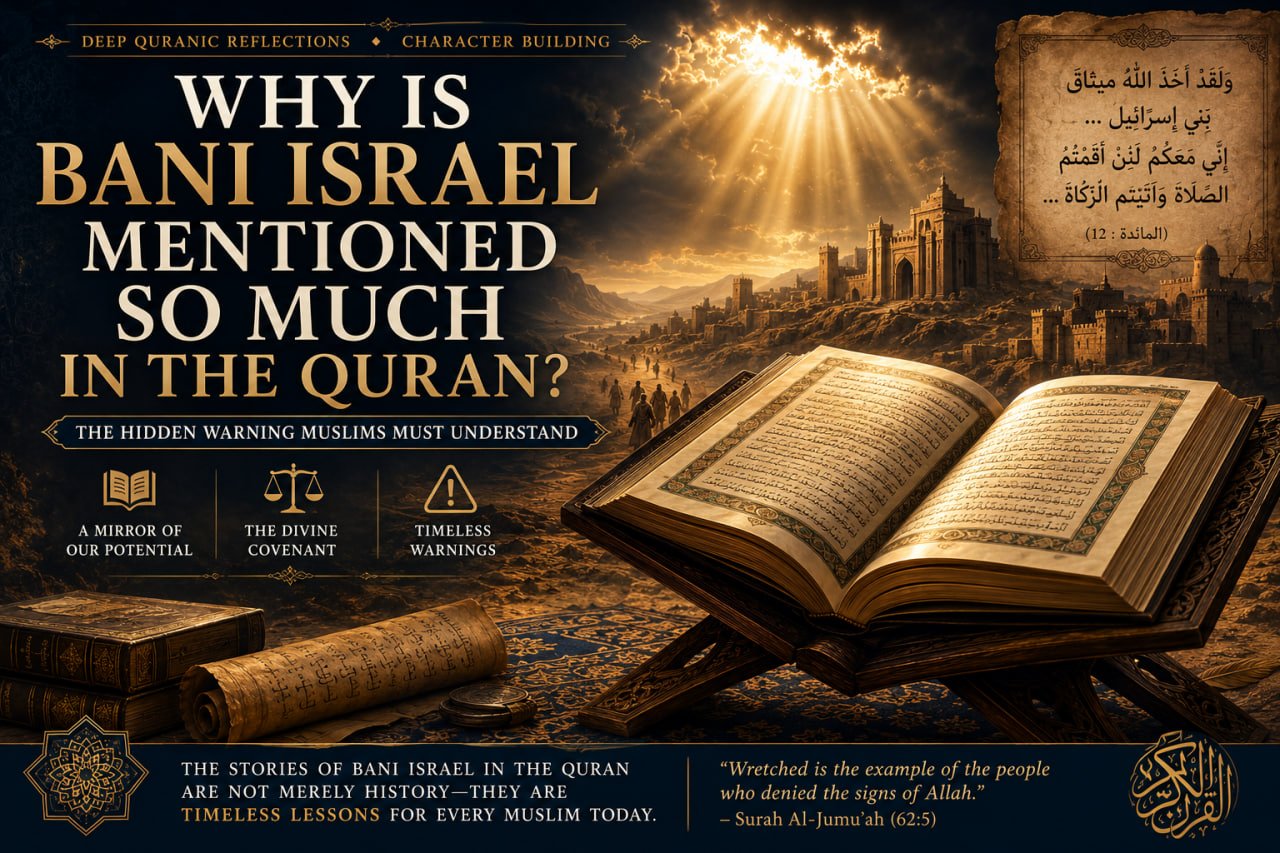

Why is Bani Israel Mentioned Most in the Quran?
The Secrets of the Divine Covenant and Lessons for Muslims Today
My dear brothers and sisters, truth-seekers, and friends. Have you ever flipped through the beautiful pages of the Quran and wondered why Almighty Allah mentions the stories of Bani Israel (the Children of Israel) so frequently?
Sometimes, a misconception creeps into our minds. We might think these lengthy historical narrations are simply historical entertainment or stories meant to fill space. But let us correct that right away: Allah’s words are far too majestic for filler. The dense, deep focus on the Children of Israel is intentionally designed as a living, breathing guide for you and me today. They are mentioned more than any other nation because their spiritual journey, their triumphs, and their monumental missteps are an exact mirror of our own potentials.
1
The Warning of the Uncarried Book
When nations before us received the Scripture, some fell into a devastating trap: they carried the physical book, but they neglected its soul. To illustrate the severe gravity of this, Allah shares an incredibly vivid, humbling parable in Surah Al-Jumu’ah.
مَثَلُ الَّذِينَ حُمِّلُوا التَّوْرَاةَ ثُمَّ لَمْ يَحْمِلُوهَا كَمَثَلِ الْحِمَارِ يَحْمِلُ أَسْفَارًا ۚ بِئْسَ مَثَلُ الْقَوْمِ الَّذِينَ كَذَّبُوا بِآيَاتِ اللَّهِ ۚ وَاللَّهُ لَا يَهْدِي الْقَوْمَ الظَّالِمِينَ
“The example of those who were entrusted with the Torah and then did not take it on is like that of a donkey who carries volumes [of books]. Wretched is the example of the people who denied the signs of Allah. And Allah does not guide the wrongdoing people.”
Think about this visual analogy with an open heart. A donkey can carry the most valuable, life-saving medical texts or deep legal codes on its back, but it remains entirely unaware of their worth. It reaps nothing from them except heavy physical burden.
The Critical Takeaway: Notice how Allah closes the verse. He doesn’t say, “Wretched is the example of Bani Israel.” Instead, He generalizes it beautifully: “Wretched is the example of the people who denied the signs of Allah.” This is an open warning card for any nation—including us, the global Muslim community.
If the people who failed to honor the Torah are compared to a beast of burden, then what happens to a Muslim who holds the final, most glorious miracle—the Holy Quran—but leaves it sitting on a high shelf to gather dust? If we do not read it, understand it, and seamlessly weave its guidance into our everyday character, behavior, and transactions, we fall beneath that very description. The text challenges us directly to step up and honor our trust.
2
Deconstructing the Twin Covenants
💡 Want to learn more about purification of the heart? Check out authentic guidelines and contemporary legal opinions over at the authoritative IslamQA Website anlongside with your IslamLight Website for deep-dive answers.
Let us look closely at the structural flow of the Quran. If you examine Surah Al-Ma’idah, you will see a brilliant structural link. In verse 7, Allah addresses the Muslim community, reminding them of their sacred bond: “And remember the favor of Allah upon you and His covenant with which He bound you…”. Then, just five verses later in verse 12, the focus transitions seamlessly into the history of the Children of Israel.
وَلَقَدْ أَخَذَ اللَّهُ مِيثَاقَ بَنِي إِسْرَائِيلَ وَبَعَثْنَا مِنْهُمُ اثْنَيْ عَشَرَ نَقِيبًا ۖ وَقَالَ اللَّهُ إِنِّي مَعَكُمْ ۖ لَئِنْ أَقَمْتُمُ الصَّلَاةَ وَآتَيْتُمُ الزَّكَاةَ وَآمَنْتُمْ بِرُسُلِي وَعَزَّرْتُمُوهُمْ وَأَقْرَضْتُمُ اللَّهَ قَرْضًا حَسَنًا لَّأُكَفِّرَنَّ عَنْكُمْ سَيِّئَاتِكُمْ وَلَأُدْخِلَنَّكُمْ جَنَّاتٍ تَجْرِي مِنْ تَحْتِهَا الْأَنْهَارُ ۚ فَمَنْ كَفَرَ بَعْدَ ذَلِكَ مِنْكُمْ فَقَدْ ضَلَّ سَوَاءَ السَّبِيلِ
“And Allāh had already taken a covenant from the Children of Israel, and We delegated from among them twelve leaders. And Allāh said, “I am with you. If you establish prayer and give zakāh and believe in My messengers and support them and loan Allāh a goodly loan, I will surely remove from you your misdeeds and admit you to gardens beneath which rivers flow. But whoever of you disbelieves after that has certainly strayed from the soundness of the way.”
We return to verse 12 of Surah Al-Ma’idah: “And Allah had already taken a covenant from the Children of Israel, and We delegated from among them twelve leaders.” What is the relationship between this verse and the verses preceding it?! Refer back to verse 7, and you will find the words of Allah, the Almighty: “And remember the favor of Allah upon you and His covenant with which He bound you…” After Allah mentioned the covenant by which He bound us as Muslims, He mentioned the covenant of the Children of Israel: “And Allah had already taken a covenant from the Children of Israel, and We delegated from among them twelve leaders.”
What is the covenant of the Children of Israel?! The continuation of the verse states: “And Allah said, ‘I am with you if you establish prayer and give zakah and believe in My messengers and support them and loan Allah a goodly loan…'” (12) This part represents the portion of the covenant that is binding upon them—namely, establishing prayer, giving zakah, believing in the messengers and supporting them, and loaning Allah a goodly loan. But what is the portion that Allah bound Himself to?! “…I will surely remove from you your misdeeds and admit you into gardens beneath which rivers flow. So whoever of you disbelieves after that has certainly strayed from the soundness of the way.” (12)
Does this covenant resemble the covenant of the Muslims, or is it a different kind of covenant?! There are contracts, such as a sales contract and a lease contract; both are contracts, but they are two different types. The contract of the Children of Israel and the contract of the Muslims are of the exact same type. When you read verse 12 from the middle, forgetting that it addresses the Children of Israel, and omit the first part—”And Allah had already taken a covenant from the Children of Israel”—and start right after it: “And Allah said, ‘I am with you if you establish prayer and give zakah and believe in My messengers and support them and loan Allah a goodly loan…'”, you feel as though Allah is speaking to the Muslims. If someone had not read “And Allah had already taken a covenant from the Children of Israel, and We delegated from among them twelve leaders,” they would not know that Allah—Glorified be He—is addressing the Children of Israel. This is exactly the covenant of the Muslims: to establish prayer, give zakah, believe in the messengers and support them, and give charity. Thus, the speech is directed at Muslims as well.
And the covenant of the Muslims is: “Allah has promised those who believe and do righteous deeds that for them there is forgiveness and a great reward.” (9) “But those who disbelieve and deny Our signs – those are the companions of Hellfire.” (10) Is this speech exclusive to the Children of Israel? No. Is it exclusive to the Children of Ishmael?! No. To whom, then, is this speech directed?! It is directed generally to all nations. This verse is general for all those who believe, as well as all those who disbelieve. Therefore, the message delivered in verse 12 is intended for Muslims, even if it is presented in the form of a story recounting what happened to a nation before us—the Children of Israel. It remains a message for you, O Muslim: “And Allah said, ‘I am with you if you establish prayer and give zakah and believe in My messengers and support them and loan Allah a goodly loan…'” The message is directed at you, for the Children of Israel today do not establish prayer, nor do they read the Quran!
The very first command, of course, is establishing prayer. It is the connection between the servant and Allah. Prayer is vital because through it, a person pauses all of their thinking regarding material things and the worldly life, connecting instead with the heavens. Thus, the soul rises by communicating with the Highest Assembly. This is a very profound matter; that is why prayer is the most important thing.
Then comes giving zakah, which is the connection between the servant and the people—and not just any people, but the most important among them: the poor. The poor person is the reason you enter Paradise, not the rich person; therefore, they are a highly crucial group. A person can amend their relationships with people of the same social status by hosting a lavish feast or buying them expensive gifts, thereby growing the bond between them—and the Prophet ﷺ said: “Give gifts to one another, and you will love one another.” However, giving zakah is intended to rectify the relationship between the rich and the poor. Society must reduce the gap between the wealthy and the impoverished. Societies where this gap widens will explode one day, like a balloon that keeps expanding until it bursts!
Therefore, the condition of the poor themselves must be improved so that the relationship between the poor and the rich can be rectified. Otherwise, how do you expect that relationship to heal?! By the rich throwing a party and inviting the poor just to hand them certificates of appreciation?! A poor person needs food, needs to feed their children, and needs to buy them necessities. Their financial condition must be improved. When this happens, feelings of malice and envy disappear from their hearts. Likewise, a sense of responsibility toward others, love for the sake of Allah, a desire to improve people’s conditions, and a drive to bridge the gap between themselves and the poor will grow within the wealthy.