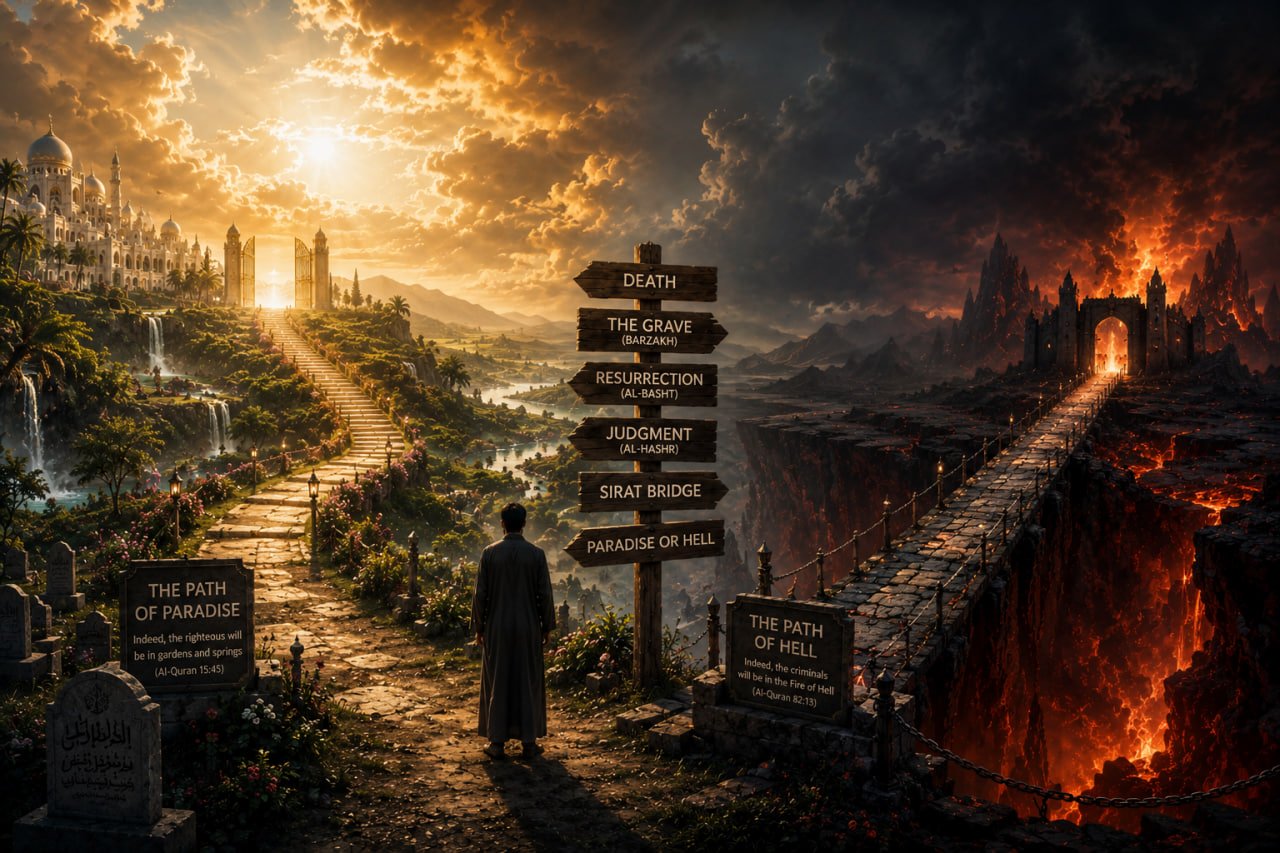

The Ultimate Roadmap of the Soul: From the Final Breath to Eternal Destiny
An Authentic Comparative Analysis for Truth-Seekers and Hearts Yearning for Certainty
To every Christian, Muslim, and sincere seeker of truth: Welcome. Take a deep breath, quiet the noise of the world around you, and let us embark together on the one journey that no human being can escape. We are currently living in the temporary waiting room of existence. Let us lift the veil to examine what awaits us on the other side.
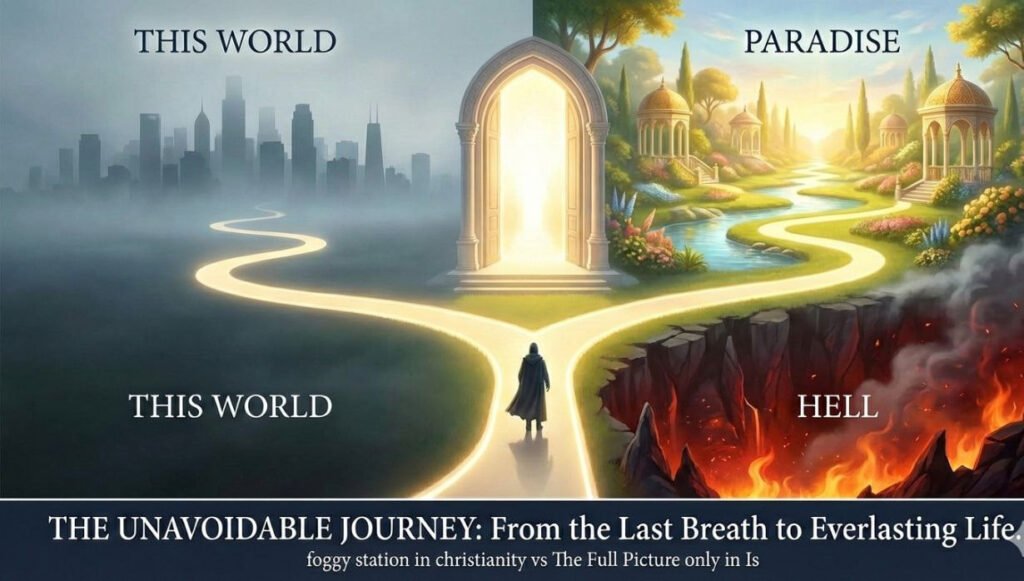
The Misty Horizon: The Afterlife Perspective in Christian Scripture
Christianity unequivocally affirms that life continues beyond physical death. However, when we closely study the foundational texts, we notice that many visual and procedural details regarding the transition remain open to interpretation. The scriptural landscape provides foundational truths but leaves certain structural gaps in the sequential roadmap of the soul.
1. The Moment of Separation and State of Waiting
In the Biblical text, the immediate sensory experience of a soul separating from the physical body lacks explicit systemic detail. The scriptures focus primarily on the certainty of the judgment rather than the mechanics of the extraction. As recorded in the Epistle to the Hebrews:
“And as it is appointed for men to die once, but after this the judgment…”
— Hebrews 9:27
While the soul transitions to await its final assessment, the texts remain silent on the exact physical form or structural experiences during this immediate intermediate state.
2. The Grave and the Intermediate Realm
Through the narrative of the rich man and Lazarus found in Luke 16, Christianity introduces the concept of “Abraham’s Bosom” as a place of comfort for the righteous, contrasting with “Hades” or the “Abyss” for the unrighteous. While this indicates that the disembodied soul retains consciousness, perception, and the capacity to experience comfort or anguish, the textual tradition does not outline specific interactive events within the physical grave itself.
3. Resurrection and Judgment
The physical resurrection of mankind is a core pillar of Christian eschatology, encapsulated in the Gospel of John:
“…for the hour is coming in which all who are in the graves will hear His voice and come forth—those who have done good, to the resurrection of life, and those who have done evil, to the resurrection of condemnation.”
— John 5:28-29
Yet, the precise procedural steps of this cosmic trial—such as the explicit weighing of individual deeds on scales, the physical distribution of personalized life ledgers, or a specific structural crossing over the abyss—are not explicitly detailed within mainstream Biblical descriptions.
4. Eternity: Heaven and Hell
The descriptions of ultimate destinations in Christian texts are largely symbolic and state-oriented. Hell is framed broadly as an unquenchable fire where “their worm does not die” (Mark 9:48), yet its exact subterranean tiers, distinct structural gates, and varying levels of retribution remain unnamed.
Conversely, Heaven is described by Jesus as a place of vast spiritual sanctuary: “In My Father’s house are many mansions…” (John 14:2). It is understood as a state of profound, everlasting spiritual joy and perfect communion with the Divine. However, specific tangible imagery concerning physical palaces, flowing rivers of varying substances, or the precise nature of physical and spiritual interaction with the Creator is left unelaborated.
The Crystal Clear Blueprint: The Complete Journey in Islamic Revelation
In sharp contrast to generalized concepts, Islamic theology provides an exceptionally detailed, step-by-step roadmap of what happens from the moment of death to the final entry into paradise or hellfire. It transforms abstract theological ideas into a vivid reality, giving the soul clear markers to understand its exact position in the cosmos.
1. The Agonies of Death (Al-Sakarāt) and the Arrival of Angels
As a person lies on their deathbed, the worldly veil is lifted, and they are met by a delegation of angels whose appearance corresponds directly to the spiritual state of the soul.
For the Believing Soul:
Angels with faces as bright as the sun descend from the heavens, carrying shouds and perfumes from Paradise. They sit at the edge of the person’s sight. Then, the Angel of Death gently approaches the head and calls out: “O pure soul, come out to forgiveness from Allah and His pleasure.” The soul flows out as smoothly as a drop of water trickling from the lip of a water-skin.
For the Disbelieving Soul:
Angels with dark, stern countenances descend carrying coarse sackcloth woven from the fires of Hell. The Angel of Death commands the soul to exit to the wrath of God. The soul scatters throughout the body and is extracted with intense friction, tearing through veins and nerves like a multi-pronged hot iron rod pulled through wet wool.
2. The Grave: The Intermediate Realm (Al-Barzakh)
Once the funeral procession departs and the sound of their retreating footsteps fades away, the soul is returned to its body in the grave for its preliminary examination. Two specialized angels, Munkar and Nakir—described as two black and blue in appearance —command the soul to sit up.
Three absolute questions are posed:
- Who is your Lord? (Man Rabbuk?)
- What is your religion? (Ma Deenuk?)
- Who is this man who was sent among you? (Man hadha ar-rajul? — referring to Prophet Muhammad, peace be upon him)
The believer answered with firm certainty granted by God “Allah”. Consequently, a portal to Paradise is opened within their grave, expanding their resting place as far as the eye can see, filling it with heavenly fragrances. Conversely, the denier falters in terror. Their grave constricts until their ribs interlock, and a window to the Hellfire opens, exposing them to its scorching heat and toxic winds until the Day of Resurrection.
3. The Resurrection and the Gathering (Al-Hashr)
The Moment of Resurrection: Between Terror and Security
At the second blowing of the Trumpet, the graves will split open, and people will emerge rushing forth. At that moment, emotions will differ greatly.
The Greatest Terror
The disbeliever will emerge stunned, his gaze fixed in horror and his heart trembling with fear. He will witness mankind, the angels, and the overwhelming realities of the Day in a state of indescribable shock.
Allah says:
“They will say, ‘O woe to us! Who has raised us up from our sleeping place?’ [The reply will be], ‘This is what the Most Merciful had promised, and the messengers told the truth.'”
The horrors of that Day will be immense. Allah says:
“O mankind, fear your Lord. Indeed, the convulsion of the Hour is a terrible thing. On the Day you see it every nursing mother will be distracted from that [child] whom she was nursing, and every pregnant woman will abort her pregnancy, and you will see the people appearing intoxicated while they are not intoxicated; but the punishment of Allah is severe.”
The Prophet Muhammad ﷺ also informed us that the sun will be brought near the people, and they will perspire according to their deeds. Some will be immersed in sweat up to their ankles, some to their knees, some to their waists, and others will be bridled by it. Narrated in Sahih Muslim.
Complete Security
As for the believer, the angels will receive him with reassurance and glad tidings.
Allah says:
“The greatest terror will not grieve them, and the angels will meet them, [saying], ‘This is your Day which you have been promised.'”
The believer will emerge in safety and hope, protected by Allah’s mercy on a Day whose length is beyond human comprehension.
Allah says:
“The angels and the Spirit will ascend to Him during a Day the extent of which is fifty thousand years.”
The Great Gathering
One of the most awe-inspiring scenes of the Hereafter is the gathering of all humanity for judgment.
The Prophet Muhammad ﷺ said:
“The sun will be brought near the people on the Day of Resurrection until it is at a distance of one mile from them.”
— Sahih Muslim
On that Day, there will be no shade except the shade granted by Allah.
The Prophet Muhammad ﷺ said:
“Seven are those whom Allah will shade in His shade on the Day when there is no shade except His shade…”
— Narrated in Sahih al-Bukhari and Sahih Muslim
May Allah gather us all beneath His shade out of His mercy and our love for one another for His sake.
The Gate of Salvation: The Intercession of Prophet Muhammad ﷺ
The journey of the Hereafter does not consist solely of fear and accountability. It also contains some of the greatest manifestations of Allah’s mercy through the intercession granted to Prophet Muhammad ﷺ.
When distress reaches its peak on the Day of Resurrection, mankind will seek someone to intercede before Allah so that judgment may begin. Eventually they will come to Prophet Muhammad ﷺ.
He said:
“I will come beneath the Throne and fall in prostration before my Lord. Then Allah will inspire me with praises and glorifications which He has not inspired to anyone before me. Then it will be said: ‘O Muhammad, raise your head. Ask, and you shall be given. Intercede, and your intercession will be accepted.'”
— Narrated in Sahih al-Bukhari and Sahih Muslim
This is known as the Great Intercession, through which the long wait of humanity comes to an end and the Reckoning begins.
His Intercession for His Nation
The intercession of Prophet Muhammad ﷺ does not end there.
When people cross the Bridge over Hell, he will stand praying for his nation.
The Prophet Muhammad ﷺ said:
“The Messenger of Allah will be standing by the Bridge saying: ‘My Lord, keep them safe; my Lord, keep them safe.'”
— Narrated in Sahih al-Bukhari and Sahih Muslim
He will also intercede, by Allah’s permission, for members of his nation who deserve punishment, and for believers who entered the Fire to be brought out from it.
The Prophet Muhammad ﷺ said:
“My intercession is for the people of major sins from my nation.”
— Narrated in Jami’ al-Tirmidhi and authenticated by many scholars.
The First to Enter Paradise
The Prophet Muhammad ﷺ said:
“I will come to the gate of Paradise on the Day of Resurrection and ask for it to be opened. The gatekeeper will say: ‘Who are you?’ I will say: ‘Muhammad.’ He will say: ‘I was commanded not to open for anyone before you.'”
— Narrated in Sahih Muslim
Allah says:
“And your Lord is going to give you, and you will be satisfied.”
The Scales and the Records
After that, the Scales will be established and the records of deeds will be distributed.
Allah says:
“And We place the scales of justice for the Day of Resurrection, so no soul will be treated unjustly at all. And if there is [even] the weight of a mustard seed, We will bring it forth. And sufficient are We as accountant.”
Every deed, no matter how small, will be accounted for.
Allah says:
“So whoever does an atom’s weight of good will see it, and whoever does an atom’s weight of evil will see it.”
The Flying of the Records
Then the records of deeds will be distributed.
The successful person will receive his record in his right hand.
Allah says:
“Then as for he who is given his record in his right hand, he will be judged with an easy account.”
As for the doomed person, he will receive his record behind his back.
Allah says:
“But as for he who is given his record behind his back, he will cry out for destruction.”
And Allah says concerning another group:
“And as for he who is given his record in his left hand, he will say, ‘Oh, I wish I had not been given my record.'”
These are among the greatest moments of the Day of Resurrection, when every soul will finally see the complete reality of what it sent forward for the meeting with its Lord.
4. The Ṣirāṭ: The Bridge Stretched Over Hellfire
After the Reckoning, the Scales, and the distribution of the records, mankind will come to one of the most decisive stages of the Hereafter: the Ṣirāṭ, the bridge stretched over Hellfire.
The Prophet Muhammad ﷺ described it as a bridge over Hell across which people must pass according to their deeds and the light that Allah grants them.
The Hooks of the Bridge
The Prophet Muhammad ﷺ said:
“Then the bridge will be laid across Hell… and on both sides of the bridge will be hooks like the thorns of Sa’dan.”
— Narrated in Sahih al-Bukhari and Sahih Muslim
He further explained that these hooks will seize people according to their deeds.
It is important to note that the exact phrase “thinner than a hair and sharper than a sword” is widely quoted in Islamic literature and mentioned by many scholars when describing the Ṣirāṭ, but this wording is not found in the well-known narrations of Sahih al-Bukhari and Sahih Muslim describing the bridge. When writing for strict authenticity, it is preferable to rely on the wording established in the authentic hadiths.
People Will Cross According to Their Light and Deeds
The believers will be given light according to their faith and righteous deeds.
Allah says:
“The Day you see the believing men and believing women, their light proceeding before them and on their right…”
— Sahih International, Qur’an 57:12
And the believers will supplicate:
“Our Lord, perfect for us our light and forgive us. Indeed, You are over all things competent.”
Different Speeds of Crossing
The Prophet Muhammad ﷺ said:
“Some will pass like the blinking of an eye, some like lightning, some like the wind, some like birds, and some like swift horses and riding camels.”
— Narrated in Sahih Muslim
People will cross according to their faith and deeds.
Some will pass with astonishing speed. Others will struggle. Some will crawl across the bridge. Others will be seized by the hooks and dragged toward Hell according to what they earned.
The Prophet Muhammad ﷺ said:
“Some will be safe and unharmed, some will be scratched and then saved, and others will be thrown into Hellfire.”
— Narrated in Sahih al-Bukhari and Sahih Muslim
During this terrifying passage, the Messenger of Allah ﷺ will stand near the bridge praying for his nation, saying:
“My Lord, keep them safe; my Lord, keep them safe.”
— Narrated in Sahih al-Bukhari and Sahih Muslim
May Allah perfect our light, make our crossing easy, protect us from the hooks of the Ṣirāṭ, and grant us safe passage to Paradise by His mercy. Ameen.
The Anatomy of Hellfire (Jahannam): A Dreaded Reality
The Abode of Humiliation
The Wrath of the Almighty and the Dwelling of Disgrace
A Terror Beyond Endurance
May Allah protect us and you from it.
The Fire of Hell contains horrors that shake the heart and humble every arrogant soul. It is the place prepared by Allah for those who knowingly rejected the truth, rebelled against their Lord, and persisted in disbelief. Its realities are enough to make hearts tremble.
1. The Description of Hellfire
Its Darkness
The Messenger of Allah ﷺ said:
“The Fire was kindled for one thousand years until it became red, then for one thousand years until it became white, then for one thousand years until it became black. So it is black and dark.”
Hellfire is not like the fire of this world. It is a darkness filled with blazing punishment.
Its Depth
The Messenger of Allah ﷺ said:
“If a stone were thrown into Hell, it would continue falling for seventy years before reaching its bottom.”
Its depth is beyond human imagination.
Its Roaring and Fury
Allah says:
“When they are thrown into it, they hear from it a [dreadful] inhaling while it boils up. It almost bursts with rage.”
2. The Food of the People of Hell
Zaqqūm
Allah says:
“Indeed, the tree of Zaqqūm is food for the sinful. Like murky oil, it boils within bellies like the boiling of scalding water.”
Allah also says:
“Its emerging fruit is as if it was heads of devils.”
Ḍarīʿ
Allah says:
“For them there will be no food except from a poisonous, thorny plant which neither nourishes nor avails against hunger.”
— Qur’an 88:6–7 (Sahih International)
Ghislīn
Allah says:
“Nor any food except from the discharge of wounds.”
3. The Drink of the People of Hell
Scalding Water (Ḥamīm)
Allah says:
“And be given drink of scalding water that will sever their intestines.”
Al-Muhl
Allah says:
“If they call for relief, they will be relieved with water like murky oil, which scalds the faces.”
4. Garments and Chains
Garments of Fire
Allah says:
“For those who disbelieved will be cut out for them garments of fire. Poured upon their heads will be scalding water.”
Garments of Pitch
Allah says:
“Their garments of liquid pitch and their faces covered by the Fire.”
Chains and Shackles
Allah says:
“Indeed, We have prepared for the disbelievers chains, shackles and a Blaze.”
And Allah says:
“Then into a chain whose length is seventy cubits insert him.”
5. Physical and Psychological Punishment
Renewed Skin
Allah says:
“Every time their skins are roasted through, We will replace them with other skins so they may taste the punishment.”
Iron Maces
Allah says:
“And for [striking] them are maces of iron.”
The Greatest Deprivation
The most painful punishment is not physical.
Allah says:
“No! Indeed, from their Lord, that Day, they will be partitioned.”
Being veiled from the sight and pleasure of Allah is among the greatest losses imaginable.
6. Regret and Hopeless Cries
The inhabitants of Hell will call out to Mālik, the keeper of Hell:
“O Mālik, let your Lord put an end to us!”
But the reply will come:
“Indeed, you will remain.”
They will then plead with Allah:
“Our Lord, remove us from it, and if we were to return [to evil], we would indeed be wrongdoers.”
The final response will be:
“Remain despised therein and do not speak to Me.”
There will be cries, regrets, and endless sorrow—but regret will no longer benefit those who refused faith and repentance when they had the opportunity.
May Allah protect us, our families, and all believers from the punishment of Hellfire and grant us entry into His Paradise by His mercy. Āmīn.
The Wonders of Paradise
A Home of Eternal Beauty and Endless Delight
After the terrors of the Day of Resurrection, the successful believers will enter the everlasting gardens prepared by Allah. No eye has seen them, no ear has heard them, and no human heart has fully imagined their reality.
The Messenger of Allah ﷺ said:
“Allah said: I have prepared for My righteous servants what no eye has seen, no ear has heard, and what has never occurred to the human heart.”
🌿 The Gardens and Environment of Paradise
Trees Beyond Imagination
The trees of Paradise are unlike anything known in this world.
The Messenger of Allah ﷺ said:
“In Paradise there is a tree under whose shade a rider could travel for one hundred years and still not cross it.”
Its vastness is beyond human comprehension.
Among the greatest wonders of Paradise is the blessed tree mentioned by Allah:
“At the Lote Tree of the Utmost Boundary. Near it is the Garden of Refuge. When there covered the Lote Tree that which covered it.”
— Qur’an 53:14–16 (Sahih International)
The Prophet Muhammad ﷺ described things covering it that no human being can adequately describe.
A Perfect Climate
Allah says:
“They will not see therein any sun or bitter cold.”
— Qur’an 76:13 (Sahih International)
There will be no scorching heat, no freezing cold, no discomfort, and no suffering. Paradise is a realm of everlasting comfort, light, peace, and tranquility.
🏛️ 2. Palaces and Furnishings
Lofty Mansions
Allah says:
“But those who have feared their Lord will have chambers, above them chambers built high.”
— Qur’an 39:20 (Sahih International)
The Messenger of Allah ﷺ said:
“The bricks of Paradise are of gold and silver, and its mortar is fragrant musk.”
Pearl Tents
The Prophet Muhammad ﷺ said:
“A tent in Paradise is a hollow pearl, sixty miles high.”
Luxurious Furnishings
Allah says:
“Reclining on beds whose linings are of brocade.”
— Qur’an 55:54 (Sahih International)
If even the inner lining is described with such magnificence, then the beauty of what is visible is beyond imagination.
Cups and Vessels
Allah says:
“And there will be circulated among them vessels of silver and cups having been created clear as glass, clear glasses made from silver.”
— Qur’an 76:15–16 (Sahih International)
A mystery of Paradise: silver as transparent as crystal.
🍇 3. Food and Drink
Rivers of Delight
Allah says:
“In it are rivers of water unaltered, rivers of milk the taste of which never changes, rivers of wine delicious to those who drink, and rivers of purified honey.”
— Qur’an 47:15 (Sahih International)
These rivers flow continuously by Allah’s command without pollution, decay, or impurity.
Fruit Within Reach
Allah says:
“And its fruit to be picked will be lowered in compliance.”
— Qur’an 76:14 (Sahih International)
The fruits come near to the believer effortlessly. Whenever a fruit is taken, Allah replaces it with another of even greater beauty.
Unimaginable Flavors
Allah says:
“For them therein is fruit.”
— Qur’an 36:57 (Sahih International)
The fruits may share names known in this world—such as grapes, pomegranates, and figs—but their reality and delight far surpass anything experienced on earth.
✨ 4. Eternal Youth and Beauty
The Form of the People of Paradise
The Messenger of Allah ﷺ said:
“The people of Paradise will enter Paradise in the form of Adam, sixty cubits tall.”
Authentic narrations also mention that they will enter in the prime of youth.
“The people of Paradise will enter Paradise at thirty-three years of age.”
There will be no sickness, weakness, aging, sadness, or death.
Garments of Honor
Allah says:
“They will wear green garments of fine silk and brocade.”
— Qur’an 18:31 (Sahih International)
These garments never wear out, fade, or become dirty.
The Fragrance of Paradise
“The fragrance of Paradise can be found from a distance of one hundred years.”
The Prophet Muhammad ﷺ also informed us that the perspiration of the people of Paradise will be like musk.
The Ḥūr al-ʿAyn
Allah describes them as:
“As if they were rubies and coral.”
— Qur’an 55:58 (Sahih International)
“Like pearls well-protected.”
— Qur’an 56:23 (Sahih International)
“Restraining their glances.”
— Qur’an 55:56 (Sahih International)
They are among the rewards Allah has prepared for the people of Paradise.
🌺 5. The Marketplace of Paradise
The Messenger of Allah ﷺ said:
“Indeed, there is a marketplace in Paradise to which they will come every Friday. Then the north wind will blow and scatter fragrance upon their faces and garments, increasing them in beauty and loveliness.”
When they return to their families, their loved ones will say:
“By Allah, you have become more beautiful and handsome after leaving us.”
And they will reply:
“By Allah, you too have become more beautiful and handsome after us.”